Robot world models improved predictably with more computing
Trained on data from 12 robot types, RoboJEPA showed predictable changes in prediction error and robotic planning performance across computing scales.
Edited by Boris Djordjevic · Paperfoot
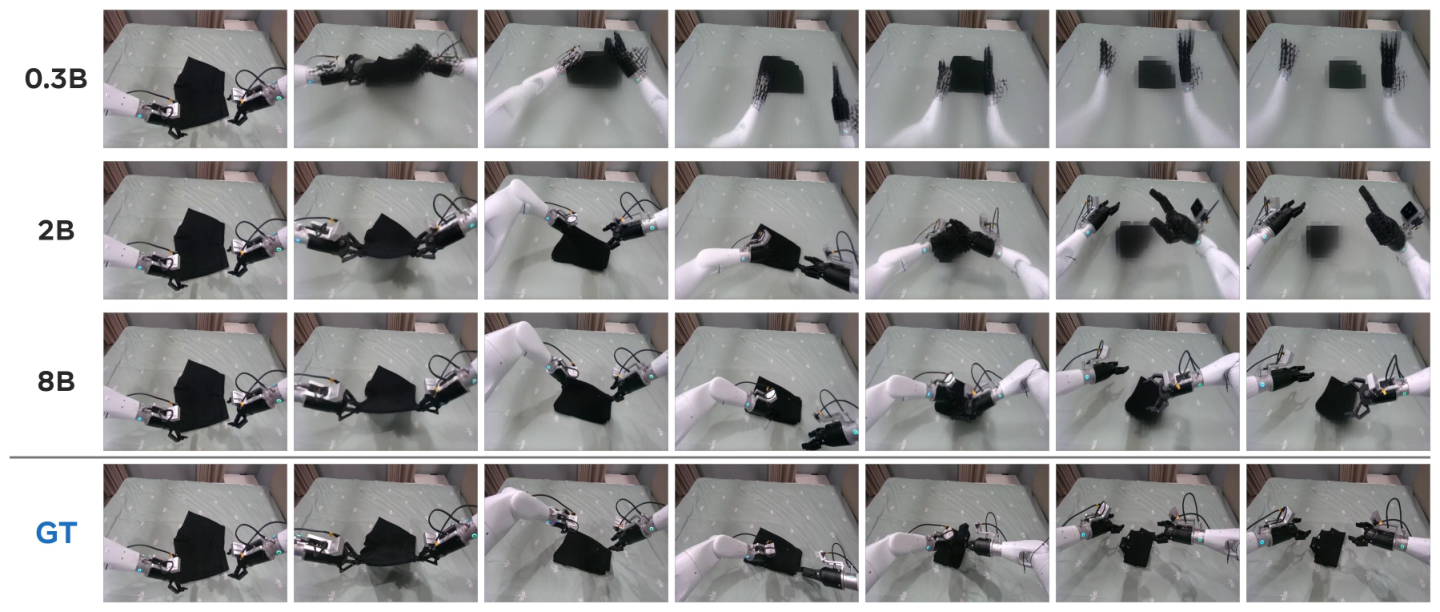
RoboJEPA, a new world model for predicting future robot states, was trained on real robot data spanning 12 robot types and evaluated on real hardware. Its errors in predicting sequences of internal states followed a mathematical relationship with computing effort. This allowed the authors to predict model quality well beyond the scale used to establish that relationship. Robotic planning performance also improved predictably with computing effort. Prediction error strongly correlated with that performance, making it a reliable proxy for real-robot evaluation.
Without task-specific training, the models planned toward a single goal image to solve tasks requiring many steps on real hardware. RoboJEPA reached eight billion parameters, the adjustable values learned during training. The authors released all saved models, along with their training and robot deployment code.
Why it matters
The scaling laws offer a principled way to estimate how robotic world models improve with computing effort. The strong link between internal prediction errors and robotic planning performance provides a proxy for real-robot evaluation.
Caveats
The abstract does not report baseline comparisons, numerical task success rates, or the number of runs conducted on physical hardware. The work is a preprint that has not yet been peer-reviewed.
From the paper
- Limitation
We scaled the predictor while keeping the V-JEPA 2.1 encoder frozen, so our laws describe a dynamics model on top of a fixed representation rather than the encoder and predictor jointly.
Quoted word for word from the full text on arXiv.
In this paper
scaling robotic latent world models
- Methods
- RoboJEPA (this paper)V-JEPA 2.1-GV-JEPA 2.1
- Datasets
- DROID (evaluated)RoboCasa (evaluated)
Results
- RoboJEPA, held-out error, on DROID, held-out error on DROID, fit on 22M–2B extrapolating to 4B and 8B: 0.6; RoboJEPA, held-out error, on RoboCasa, held-out error on RoboCasa, fit on 22M–2B extrapolating to 4B and 8B: 1.4× 10^{-3}
The second-order power law extrapolates best, with a held-out error of 0.6 and 1.4× 10^{-3} on DROID and RoboCasa respectively, roughly 2 – 3× lower than the standard power law ( 2.0 and 3.7× 10^{-3} ) and below both BNSL and UNSL.
3.1 World Model Scaling Laws
- RoboJEPA, irreducible error, on DROID, on DROID: ≈ 0.2; RoboJEPA, irreducible error, on RoboCasa, on RoboCasa: ≈ 0.17
Interestingly, the two best candidates, the second-order law and BNSL, estimate nearly the same irreducible error, ≈ 0.2 on DROID and ≈ 0.17 on RoboCasa, indicating that RoboJEPA is close to saturation on both evaluations under its current training and data budget.
3.1 World Model Scaling Laws
What it shows
- RoboJEPA's imagination error follows a second-order power law in compute, allowing model quality prediction beyond the scale at which the law is fit.
We show that RoboJEPA's imagination error, the error of its latent rollouts, follows a second-order power law in compute, allowing us to predict model quality well beyond the scale at which the law is fit.
Abstract
- Downstream robotic planning performance improves predictably with compute, and imagination error correlates strongly with it.
We further show that downstream robotic planning performance improves predictably with compute, and that imagination error is strongly correlated with it, making it a reliable proxy for real-robot evaluation.
Abstract
- Latent world models can be deployed zero-shot as robotic agents, planning toward a single goal image to solve tasks requiring long-horizon planning on real hardware.
Finally, we demonstrate that latent world models can be deployed zero-shot as robotic agents, planning toward a single goal image to solve tasks requiring long-horizon planning on real hardware.
Abstract
- RoboJEPA scales from 22M to 8B parameters, with the 8B model being the largest JEPA predictor model trained to date.
We presented a recipe for scaling the predictor that works from 22M to 8B parameters, the latter being the largest JEPA predictor model trained to date.
5 Conclusion
- RoboJEPA scales the predictor while keeping the V-JEPA 2.1 encoder frozen, describing dynamics on top of a fixed representation rather than the encoder and predictor jointly.
We scaled the predictor while keeping the V-JEPA 2.1 encoder frozen, so our laws describe a dynamics model on top of a fixed representation rather than the encoder and predictor jointly.
5 Conclusion
Quoted word for word from the full text on arXiv.
The paper
RoboJEPA: Scaling Robotic Latent World Models
arXiv, Oct 7, 2026, Open access, CC BY, Preprint, not peer-reviewed
doi.org/10.48550/arxiv.2610.10515
arXiv:2610.10515v1 in cs.AI, also cs.RO
Cite as BibTeX
@misc{zholus2026robojepa,
  title = {RoboJEPA: Scaling Robotic Latent World Models},
  author = {Zholus, Artem and Beltran-Velez, Nicolas and Yuan, Jianhao and Chandar, Sarath and Nagarajan, Tushar and Severo, Daniel and Sinha, Koustuv and Drozdzal, Michal and Soriano, Adriana Romero and Bohg, Jeannette and Ballas, Nicolas and Assran, Mahmoud},
  year = {2026},
  eprint = {2610.10515},
  archivePrefix = {arXiv},
  primaryClass = {cs.AI},
  doi = {10.48550/arxiv.2610.10515},
  url = {https://arxiv.org/abs/2610.10515}
}