A proof shows when predictive models learn matching patterns
Paired views of one scene needed 42 times fewer training samples than predicting the next piece of text to match alignment on the same text collection.
Edited by Boris Djordjevic · Paperfoot
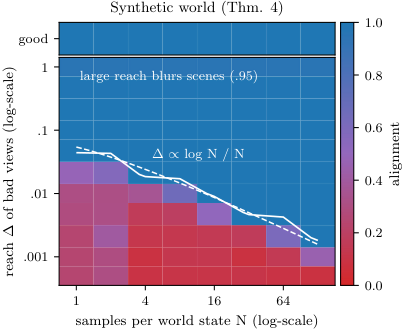
The preprint proved a Platonic Representation Theorem for Joint-Embedding Predictive Architectures, models trained to predict an internal description of one observation from another, across different kinds of data. When training pairs showed the same scene, separately trained models learned matching representations apart from a rotation of their coordinates. For other pairs, the theorem bounded the mismatch.
The researchers tested alignment—how closely models’ internal descriptions matched—using datasets ranging from 145,000 captions to text accompanying 940 million web images. Training with same-scene pairs needed 42 times fewer samples than predicting the next piece of text to reach the same alignment on the same text collection. The authors interpreted this as evidence that paired observations, not scale alone, were the lever for building shared representations.
Why it matters
The proof gave conditions under which models trained separately on different kinds of data could share an internal description. The tests supported choosing training pairs as a route to closer alignment, rather than relying on scale alone.
Caveats
The matching-representation guarantee was conditional on same-scene pairs and allowed a rotation. The work is a preprint; the abstract does not specify the mismatch bound for other pairs.
In this paper
platonic representation learning across modalities
- Methods
- Joint-Embedding Predictive Architecture (JEPA) (this paper)good-view JEPA (this paper)bad-view JEPA (baseline)next-token prediction (baseline)BERTViT-S/16DINOv2CLIP
- Datasets
- COCO (evaluated)ImageNet-100 (evaluated)Flickr30k (evaluated)MSR-VTT (evaluated)Recap-DataComp (training)WIT (evaluated)
Results
- good-view JEPA, zero-shot accuracy, on ImageNet-100, pair-free benchmark: 64%
Even that rotation needs no pair: on the latest pair-free benchmark, our text JEPA beats every zero-shot accuracy reported with language models up to 8B parameters, e.g., 64% against at most 56% top-5 on ImageNet-100.
Abstract
- Joint-Embedding Predictive Architecture (JEPA), CIDEr, on COCO: .838
As a showcase, one rotation turns separately trained encoders into an image captioner (CIDEr .838 on COCO).
Abstract
- good-view JEPA, image to caption retrieval R@1, through one rotation: 4.4%
Second, with caption views the true caption is retrieved first for 4.4% of test images through one rotation, 44 times chance, while masked spans and next-token prediction, trained on the same captions with the same encoder, nearly coincide and stay well below–a ranking that holds in every seed, with gaps several times the seed spread …
3.1 Good Views Align Across Modalities
- good-view JEPA, scene-explained fraction rho, k=32: .804; bad-view JEPA, scene-explained fraction rho, k=32: .655; next-token prediction, scene-explained fraction rho, k=32: .608
For k=32, the scene explains a fraction \rho of.804 of the good-view JEPA’s embedding, against.655 for the bad-view JEPA and.608 for next-token prediction (each within ±.005 across seeds), so Section 2.3 bounds their best-rotation error against DINOv2 below by 12.6, 22.1 and 25.1 (from the unrounded fractions), which the measured errors (33.5, 39.4 and 40.3) respect and follow in order; k=128 gives the same ordering (Table 6 …
3.1 Good Views Align Across Modalities
- good-view JEPA, mutual 10-NN, on MSR-VTT, when both sides have good views: .067; good-view JEPA, mutual 10-NN, on MSR-VTT, with good text views only: .059; good-view JEPA, mutual 10-NN, on MSR-VTT, with good image views only: .043
Good views raise mutual 10-NN on each side, in every seed, the text side much more than the image side:.067 when both sides have good views,.059 with good text views only,.043 with good image views only and.039 with neither (same ordering in each seed; chance.01; Figures 8 and 13).
3.3 Good Views Help on Both Sides
- good-view JEPA, alignment, on WIT, on the alt-text and a text-only paraphrase of it: .060
Without any image captioner, good views on the alt-text and a text-only paraphrase of it reach.060 on WIT against.107 with the recaptions (Table 7), so the comparisons with language models and CLIP’s text encoder at scale rely on these texts, while the comparisons between views, on identical texts, do not …
7 Conclusion
What it shows
- Joint-Embedding Predictive Architectures trained separately on any number of modalities learn the same representation up to one rotation when their positive pairs are observations of one scene and misalignment is bounded otherwise.
First, we prove a Platonic Representation Theorem: Joint-Embedding Predictive Architectures (JEPAs) trained separately on any number of modalities learn the same representation up to one rotation whenever their positive pairs are two observations of one scene–good views–and their misalignment is bounded otherwise …
Abstract
- Next-token prediction is an instance of a JEPA with corruptions of a single document as views, which explains why language models align with vision only through scale.
Second, we show that next-token prediction is a JEPA with bad views, parts of a single document, which explains why language models align with vision only through scale.
Abstract
- Positive views drawn from observations of the same scene require 42 times fewer training samples than next-token prediction on the same corpus to attain equal alignment.
Good views need 42 times fewer training samples than next-token prediction on the same corpus to reach the same alignment, and a 109M-parameter text JEPA aligns with DINOv2 and CLIP's image encoders better than every language model we evaluated, up to 72B parameters, and than CLIP's text encoder: next-token prediction is a remarkably inefficient route to platonic representations …
Abstract
- Unpaired data alone can determine the rotation well enough to exceed every pair-free zero-shot classification accuracy reported with language models up to 8B parameters.
Empirically, good views align best across data, encoders and modalities, follow a scaling law that predicts unseen runs within seed noise, need 42 times fewer samples than next-token prediction on the same corpus, and give a 109M text JEPA that beats every language model we evaluated, up to 72B parameters, on the PRH paper’s own benchmark, and a captioner whose only parameters fitted on image–caption pairs are those of one rotation, which unpaired data alone can find well enough to beat every pair-free zero-shot classification reported with language models up to 8B parameters …
7 Conclusion
- The theoretical guarantees are population statements over finite worlds with injective renderings and matched marginals, whereas practical modalities are lossy and training relies on network inductive bias.
Our theorems are population statements over a finite world with injective renderings and matched marginals; real modalities are lossy, and finite-sample training relies on the network’s inductive bias.
7 Conclusion
Quoted word for word from the full text on arXiv.
The paper
Proving and Improving the Platonic Representation Hypothesis with JEPAs
arXiv, Oct 29, 2026, Open access, CC BY, Preprint, not peer-reviewed
doi.org/10.48550/arxiv.2610.39302
arXiv:2610.39302v1 in cs.AI, also cs.CV, stat.ML
Cite as BibTeX
@misc{balestriero2026proving,
  title = {Proving and Improving the Platonic Representation Hypothesis with JEPAs},
  author = {Balestriero, Randall and LeCun, Yann},
  year = {2026},
  eprint = {2610.39302},
  archivePrefix = {arXiv},
  primaryClass = {cs.AI},
  doi = {10.48550/arxiv.2610.39302},
  url = {https://arxiv.org/abs/2610.39302}
}