A navigation system matches human followers on a benchmark test
On a navigation benchmark, NavGPT-3 scored 90.43 in success against 90.4 for human followers, and 78.47 in path fidelity against 77.7.
Edited by Boris Djordjevic · Paperfoot
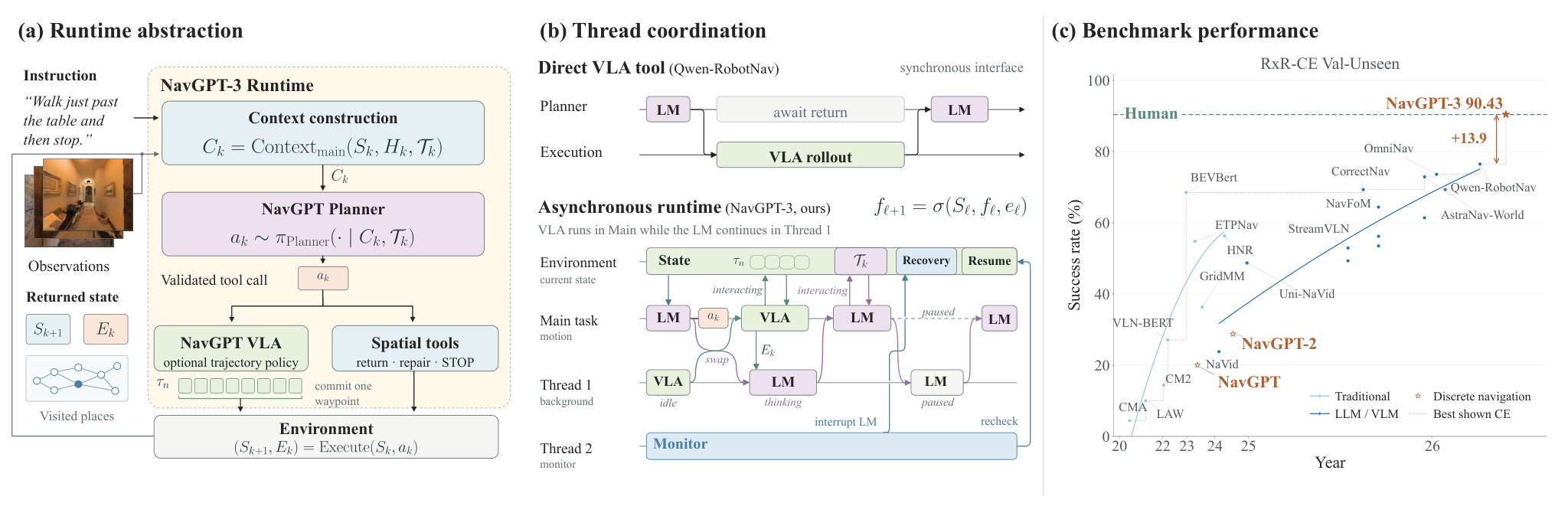
In a preprint, researchers built NavGPT-3, a harness and runtime system that connects a reasoning language model to a robot action policy for navigation tasks. The system manages reasoning, acting, and monitoring as separate threads, allowing the action policy to interrupt and react quickly to sudden events. Beneath the runtime, the team trained an eight-billion-parameter action policy on 19.28 million examples.
Tested alone, this action model reached a 76.94 success rate on the R2R-CE navigation benchmark and led RxR-CE with 82.39. The full NavGPT-3 system set a state-of-the-art success rate of 81.51 on R2R-CE. On RxR-CE, it matched human followers, scoring 90.43 against 90.4 in success and 78.47 against 77.7 in path fidelity, taking 1 minute 22 seconds per episode versus roughly 3 minutes for humans. The action policy cut minimum reaction times from 3 to 19 seconds down to 0.5 to 1 second per step.
Why it matters
The results on public navigation benchmarks demonstrate that an operating-system-style interface can bridge slow high-level reasoning with fast motor control in embodied systems. This shows engineers how to let reasoning language models guide physical robots without sacrificing quick reaction times.
Caveats
The abstract reports results on navigation benchmarks without stating whether the system was evaluated on physical hardware in the real world, and it does not report variance across runs. The paper is also a preprint that has not yet been peer-reviewed.
In this paper
embodied navigation
- Methods
- NavGPT-3 (this paper)NavGPT VLA (this paper)Qwen-RobotNav (baseline)Qwen3-VL-InstructGPT-6 AstraClaude Opus 5Gemini 3.1 Pro
- Datasets
- R2R-CE (evaluated)RxR-CE (evaluated)MP3D (evaluated)HM3D v2 (evaluated)OpenScene (training)nuScenes (training)VLNVerse (training)RoboCasa (training)HM3D (training)LocateAnything-Data (training)
Results
- NavGPT-3, SR, on R2R-CE, complete harness: 81.51 SR
With the complete harness, NavGPT-3 sets the state of the art on R2R-CE (81.51 SR) and, for the first time, brings an autonomous agent to human level: on RxR-CE it matches human followers in success (90.43 vs. 90.4 SR) and path fidelity (78.47 vs. 77.7 nDTW) at 1 min 22 s per episode, versus roughly 3 min for a human …
Abstract
- NavGPT-3, success, on RxR-CE: 90.43; NavGPT-3, path fidelity, on RxR-CE: 78.47; NavGPT-3, time per episode, on RxR-CE: 1 min 22 s per episode
… on RxR-CE it matches human followers in success (90.43 vs. 90.4 SR) and path fidelity (78.47 vs. 77.7 nDTW) at 1 min 22 s per episode, versus roughly 3 min for a human …
Abstract
- NavGPT VLA, minimum reaction time: 0.5-1 s per action-policy step
… when NavGPT VLA executes the route, the reasoning loop shortens and the system's minimum reaction time falls from 3-19 s per language-model decision to 0.5-1 s per action-policy step (1-2 Hz …
Abstract
- NavGPT-3, revision SR, Combining both: 83.3; NavGPT-3, accepted stale commands, Combining both: 1/30; NavGPT-3, resume SR, Combining both: 80.0
Combining both yields the highest revision SR (83.3 vs. 73.3 for sequential queued handling), the fewest accepted stale commands (1/30), and the highest resume SR (80.0).
Results.
- NavGPT-3, repair time, under queued handling: 9.6 s; NavGPT-3, repair time, under priority handling: 7.9 s
Overlapping Planner reasoning with VLA execution shortens repair from 12.8 to 9.6 s under queued handling and from 11.5 to 7.9 s under priority handling, because execution continues while the Planner reviews the route.
Results.
What it shows
- NavGPT-3 matches human followers on RxR-CE in success rate and path fidelity under continuous control while executing at 1 min 22 s per episode.
… on RxR-CE it matches human followers in success (90.43 vs. 90.4 SR) and path fidelity (78.47 vs. 77.7 nDTW) at 1 min 22 s per episode, versus roughly 3 min for a human …
Abstract
- NavGPT-3 with its complete harness sets the state of the art on R2R-CE with 81.51 SR.
With the complete harness, NavGPT-3 sets the state of the art on R2R-CE (81.51 SR) and, for the first time, brings an autonomous agent to human level: on RxR-CE it matches human followers in success (90.43 vs. 90.4 SR) and path fidelity (78.47 vs. 77.7 nDTW) at 1 min 22 s per episode, versus roughly 3 min for a human …
Abstract
- Executing routes with NavGPT VLA shortens the reasoning loop and reduces minimum reaction time to 0.5-1 s per action-policy step.
… when NavGPT VLA executes the route, the reasoning loop shortens and the system's minimum reaction time falls from 3-19 s per language-model decision to 0.5-1 s per action-policy step (1-2 Hz …
Abstract
- NavGPT VLA 8B alone reaches 76.94 SR on R2R-CE and leads RxR-CE with 82.39 SR.
Beneath it, our action policy NavGPT VLA, trained on 19.28M examples, allocates visual tokens using codec allocation, in proportion to scene change; its 8B model alone reaches 76.94 SR on R2R-CE and leads RxR-CE with 82.39 SR.
Abstract
- Combining reasoning overlap and priority handling achieves the highest revision success rate, the fewest accepted stale commands, and the highest resume success rate in runtime evaluation.
Combining both yields the highest revision SR (83.3 vs. 73.3 for sequential queued handling), the fewest accepted stale commands (1/30), and the highest resume SR (80.0).
Results.
Quoted word for word from the full text on arXiv.
The paper
NavGPT-3: Harnessing Context in a Hierarchical Navigation Runtime
arXiv, Oct 7, 2026, Open access, CC BY, Preprint, not peer-reviewed
doi.org/10.48550/arxiv.2610.10787
arXiv:2610.10787v2 in cs.RO, also cs.AI, cs.CL, cs.CV, cs.LG
Comments: 36 pages, 14 figures. Project page: https://metacognitionai.github.io/NavGPT3/
Cite as BibTeX
@misc{zhou2026navgpt3,
  title = {NavGPT-3: Harnessing Context in a Hierarchical Navigation Runtime},
  author = {Zhou, Gengze and Hong, Yicong and Zhang, Jiazhao and Zhao, Xunyi and Zhou, Jian and Lei, Zixing and Wang, Zun and Zhao, Chongyang and Chen, Xionghui and Gould, Stephen and van den Hengel, Anton and Wu, Qi},
  year = {2026},
  eprint = {2610.10787},
  archivePrefix = {arXiv},
  primaryClass = {cs.RO},
  doi = {10.48550/arxiv.2610.10787},
  url = {https://arxiv.org/abs/2610.10787}
}