Multi-image tests often reward using just one image
An audit of about 33,000 questions across 19 public benchmarks found that one image or the question alone settled 24.2%.
Our read
- Studied:
- Preprint: benchmark or dataset
Editor of record: Boris Djordjevic · Paperfoot
The team built ASTERISM, a benchmark of 18,700 questions requiring more than one image, assembled from 19 public benchmarks to test models that process text and images. Their audit identified questions in the source benchmarks that allowed a single-image shortcut.
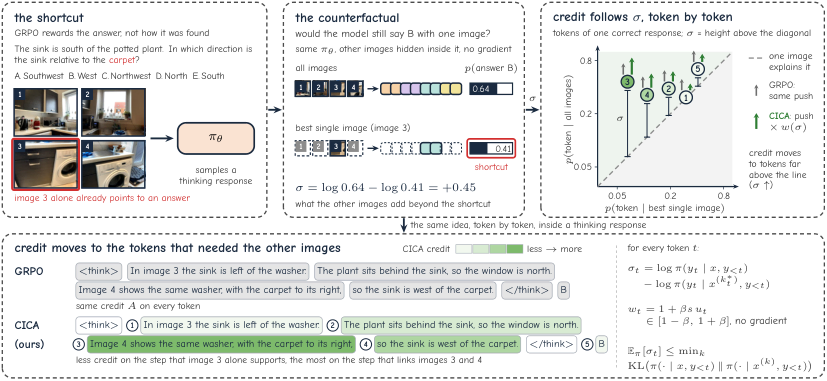
On shortcut questions, one image recovered a median 78% of the accuracy gain that all images added over text alone. Even where one image was insufficient, most wrong answers repeated an answer the model gave from one image, well above chance. The researchers also tested cross-image credit assignment, a training method that shifted credit toward parts of answers needing multiple images. On three open-source models, it raised ASTERISM scores by 2.6 to 6.0 points—more than twice the gain of each general-purpose and image-specific reward-based training objective tested on the same data.
Why it matters
The audit showed how test scores can reward shortcuts rather than combining evidence. ASTERISM gives researchers a test set designed to require evidence from multiple images.
Caveats
The results concern benchmark questions, and the training gains came from three open-source models. The paper is a preprint and has not been peer-reviewed.
In this paper
multi-image benchmark evaluation and reasoning for multimodal large language models
- Methods
- cross-image credit assignment (CICA) (this paper)CICA-Qwen2.5-VL-7B (this paper)CICA-GLM-4.1V-9B-Thinking (this paper)CICA-Qwen3.5-9B (this paper)group relative policy optimization (GRPO) (baseline)DAPO (baseline)APPO (baseline)VGPO (baseline)CFPO (baseline)Qwen2.5-VL-7B (baseline)Qwen3.5-9B (baseline)Claude Opus 5.5 (evaluated)
- Datasets
- ASTERISM (this paper)ASTERISM-Lite (this paper)ASTERISM-Train (this paper)MuirBench (evaluated)Q-Bench2 (evaluated)MIRB (evaluated)MaRVL (evaluated)MV-MATH (evaluated)MileBench (evaluated)POPE (evaluated)
Results
- cross-image credit assignment (CICA), ASTERISM score, trained on ASTERISM-Train: 2.6 to 6.0 points
We show that it improves three backbones by 2.6 to 6.0 points, more than any of the five RL objectives trained on the same data, and that its gains over them are larger with all images visible than with one.
1 Introduction
- Qwen2.5-VL-7B, gain, on ASTERISM: at most 1.6 points
Twenty-two public post-trained variants of Qwen2.5-VL-7B, most of them trained with RL, gain at most 1.6 points on ASTERISM (Tabs. S9 and S10), and five RLVR objectives, two general and three designed for visual inputs, add little to any backbone that we train (Tab. 4).
1 Introduction
- cross-image credit assignment (CICA), share of a training step, on Qwen2.5-VL-7B: about 9%
It adds only one gradient-free pass per image for each response, which takes about 9% of a training step on Qwen2.5-VL-7B (Sec. F.7).
5.2 CICA improves each backbone
What it shows
- One image or the question alone settles 24.2% of the items across 19 public multi-image benchmarks.
One image or the question alone settles 24.2% of the items of 19 public benchmarks, and even on items that need more than one image, the wrong answers of each of 31 open-source MLLMs repeat a one-image answer more often than a matched chance level (Sec. 2).
1 Introduction
- Across 23 open-source MLLMs, models recover a median 78% of their all-image gain from a single image on removed benchmark items compared to 18% on retained ASTERISM items.
With one image visible and the others grayed out, 23 open-source MLLMs recover a median 78% of their all-image gain, the accuracy that all images add over the text alone, on the items the audit removes, but 18% on the items it keeps (Secs. 2.2 and 1).
1 Introduction
- On items requiring multiple images, 75–85% of wrong answers from Qwen2.5-VL-7B, Qwen3.5-9B, and GLM-4.1V-9B-Thinking repeat single-image answers.
On such items, 75–85% of the wrong answers of Qwen2.5-VL-7B, Qwen3.5-9B and GLM-4.1V-9B-Thinking repeat an answer that the model gives from a single image, where chance would give about half (Fig. 1).
1 Introduction
- CICA raises the ASTERISM score of three open-source backbones by 2.6 to 6.0 points, outperforming general and vision-specific RL baselines.
CICA raises the ASTERISM score of the base model by 2.6 to 6.0 points and scores above every RL baseline on all three backbones, with all paired 95% intervals above zero (Tab. 4; Secs. H.3 and H.7).
The gains exceed those of the RL baselines.
- Although CICA trains exclusively on multi-image items, it preserves or improves performance across ten single-image benchmarks.
Although CICA trains only on multi-image items, it keeps or raises the score of each backbone on all ten single-image benchmarks (Tab. S18).
Single-image scores are kept or raised.
Quoted word for word from the full text on arXiv.
The paper
ASTERISM: Do Multimodal LLMs Actually Look at All the Images?
arXiv, Nov 24, 2026, Open access, Preprint, not yet peer-reviewed
doi.org/10.48550/arxiv.2611.32316
arXiv:2611.32316v1 in cs.CV, also cs.AI, cs.CL, cs.LG
Comments: Code and datasets: https://github.com/chanseul01/ASTERISM
Cite as BibTeX
@misc{cho2026asterism,
  title = {ASTERISM: Do Multimodal LLMs Actually Look at All the Images?},
  author = {Cho, Chanseul and Kim, Dongwoo and Bae, Noori and Moon, Seungjae and Lee, Seongsu and Ro, Youngmin},
  year = {2026},
  eprint = {2611.32316},
  archivePrefix = {arXiv},
  primaryClass = {cs.CV},
  doi = {10.48550/arxiv.2611.32316},
  url = {https://arxiv.org/abs/2611.32316}
}