Image-and-text models fared no better than chance on new test
All 22 models scored at or below chance on CompoSET, which pairs images differing by one controlled edit, despite doing well on earlier benchmarks.
Our read
- Studied:
- Preprint: benchmark or dataset
Editor of record: Boris Djordjevic · Paperfoot
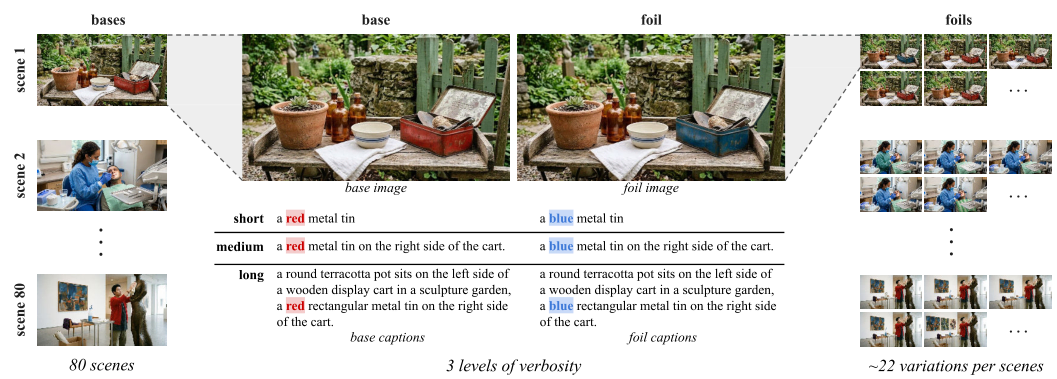
Researchers introduced CompoSET, an image-caption matching benchmark, and tested 22 models on image pairs differing by a single controlled edit. These “dual-encoder” models process images and text separately before comparing them. The benchmark contains 1,776 instances across 80 naturalistic scenes, covering 16 edit types. Each base scene has about 22 edited counterparts, allowing researchers to separate scene difficulty from edit difficulty.
Only 8% of pixels changed on average between paired images, compared with 97% in existing benchmarks. All 22 models scored at or below chance when ranking image-caption matches, despite scoring well on earlier benchmarks. The authors said this suggested that apparent progress on earlier tests may reflect broader image differences rather than the ability to match specific properties and relationships across images and captions.
Why it matters
By keeping paired images nearly identical, CompoSET gives researchers a more controlled benchmark for testing whether models match specific details across images and captions.
Caveats
The results concern the 22 dual-encoder models tested, not every kind of image-and-text model. The work is a preprint and has not been peer-reviewed.
From the paper
- Limitation
CompoSET contains 80 scenes and 1,776 instances: smaller than SugarCrepe, larger than Winoground or What’s Up.
Quoted word for word from the full text on arXiv.
In this paper
vision-language compositionality
- Methods
- CLIP (evaluated)CLIP B/32 (evaluated)CLIP B/16 LAION-2B (evaluated)SigLIP (evaluated)SigLIP B/16 (evaluated)SigLIP-2 (evaluated)SigLIP-2 SO400M/14 (evaluated)SigLIP-2 SO400M (evaluated)NegCLIP B/32 (evaluated)DreamLIP B/16 (evaluated)Gemini 2.5 Flash (evaluated)Claude Sonnet 4.6 (evaluated)
- Datasets
- Compositional Single-EdiT (CompoSET) (this paper)Winoground (evaluated)BiVLC (evaluated)ColorSwap (evaluated)MMVP (evaluated)NaturalBench (evaluated)What’s Up (evaluated)ColorBench-robust (evaluated)SPEC (evaluated)EqBen (evaluated)
Results
- SigLIP-2 SO400M/14, Group score, on Compositional Single-EdiT (CompoSET): 13.9%
The best CompoSET Group score is 13.9% (SigLIP-2 SO400M/14, 95% CI [12.3,15.5]; scene-clustered bootstrap CI [12.4,15.5]; n{=}1,776 ), below the 16.67% chance level.
Results.
- DreamLIP B/16, Group score, on Compositional Single-EdiT (CompoSET): 13.7%
DreamLIP B/16 is close behind at 13.7%, despite training on substantially less data.
Results.
- SigLIP-2 SO400M, score, on BiVLC: 49.5%; SigLIP-2 SO400M, score, on ColorSwap: 39.7%; SigLIP-2 SO400M, score, on MMVP: 31.1%
The same SigLIP-2 SO400M scores 49.5% on BiVLC, 39.7% on ColorSwap, and 31.1% on MMVP.
Results.
- CLIP B/32, CompoSET Group, on Compositional Single-EdiT (CompoSET): 4.4%; CLIP B/16 LAION-2B, CompoSET Group, on Compositional Single-EdiT (CompoSET): 7.8%; SigLIP B/16, CompoSET Group, on Compositional Single-EdiT (CompoSET): 10.2%
CompoSET Group rises from CLIP B/32 (4.4%) to CLIP B/16 LAION-2B (7.8%), SigLIP B/16 (10.2%), and SigLIP-2 SO400M/14 (13.9%).
Results.
- NegCLIP B/32, score, on Compositional Single-EdiT (CompoSET): 7.0%
NegCLIP B/32 scores 7.0% on CompoSET, below CLIP B/16 LAION-2B at 7.8%.
Results.
- DreamLIP B/16, score, swap_color: 18.6%
The one exception is consistent with the caption-enrichment finding above: DreamLIP B/16 reaches 18.6% on swap_color (its own modify_color: 52.4%), suggesting dense-recaption, multi-positive pretraining confers some binding signal as well.
Results.
- Claude Sonnet 4.6, Group, on Compositional Single-EdiT (CompoSET), stratified 200-instance subset: 42.5%; Gemini 2.5 Flash, Group, on Compositional Single-EdiT (CompoSET), stratified 200-instance subset: 12.0%
Under this protocol, Claude Sonnet 4.6 reaches 42.5% Group on CompoSET, about 3× the best dual-encoder ceiling and well above chance; Gemini 2.5 Flash and Claude Haiku 4.5 reach 12.0% and 13.0%.
Results.
What it shows
- All tested dual-encoder vision-language models perform at or below chance level on the CompoSET benchmark.
We test 22 dual-encoder VLMs and find that all models perform at or below chance level on CompoSET, despite scoring well on prior benchmarks.
Abstract
- Scaling the dual-encoder architecture and training data improves controlled compositional discrimination scores only modestly without solving the controlled task.
Scaling the dual-encoder recipe improves controlled compositional discrimination only modestly.
Results.
- Dual encoders trained with text-side hard negatives do not transfer effectively to controlled image-side foils.
Text-side hard negatives do not transfer to image-side foils.
Results.
- Pretraining with dense recaptioning provides robustness against caption length dilution, where most dual encoders degrade as surrounding context grows.
This is the main empirical payoff of the verbosity axis: most dual encoders lose the edit as context grows, while dense multi-positive caption supervision partially protects it.
Results.
- Matched modify and swap contrasts reveal that attribute binding collapses even when attribute detection remains intact.
Attribute detection therefore partially survives while attribute binding collapses.
Results.
Quoted word for word from the full text on arXiv.
The paper
CompoSET: A Controlled Single-Edit Benchmark for Vision-Language Compositionality
arXiv, Oct 30, 2026, Open access, CC BY-SA, Preprint, not yet peer-reviewed
doi.org/10.48550/arxiv.2610.41118
arXiv:2610.41118v1 in cs.CV
Comments: Dataset: https://huggingface.co/datasets/CompoSET/CompoSET | Code: https://github.com/laure-delisle/CompoSET | 9 pages main text, 38 pages total
Cite as BibTeX
@misc{delisle2026composet,
  title = {CompoSET: A Controlled Single-Edit Benchmark for Vision-Language Compositionality},
  author = {Delisle, Laure and Perona, Pietro},
  year = {2026},
  eprint = {2610.41118},
  archivePrefix = {arXiv},
  primaryClass = {cs.CV},
  doi = {10.48550/arxiv.2610.41118},
  url = {https://arxiv.org/abs/2610.41118}
}