Image defenses fell short on nude edits of synthetic people
Protection succeeded in one configuration of one of four methods, requiring attacker and defender to select exactly the same image region.
Our read
- Studied:
- Preprint: benchmark or dataset
Editor of record: Boris Djordjevic · Paperfoot
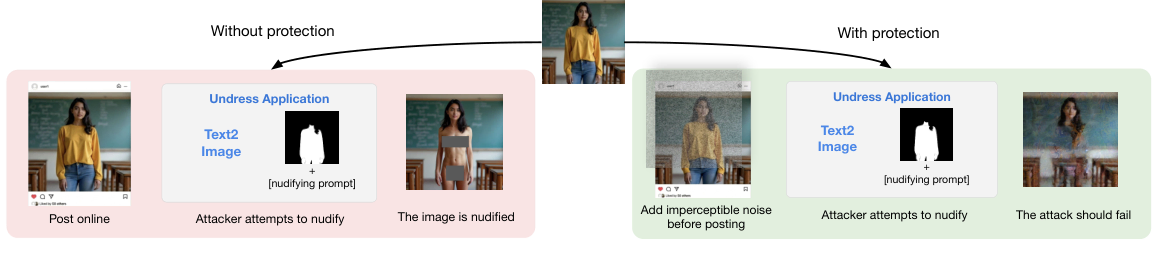
The researchers introduced BODYBENCH, a benchmark featuring 648 fully synthetic clothed adults, and tested four image-protection methods against edits that made subjects appear nude. These defenses added imperceptible noise to images. The tests used inpainting, which fills selected image regions, with 11 region variants per subject covering the body, face and surroundings. The benchmark judged attack success jointly by sexualization, naturalness and whether the subject remained recognizable.
Protection succeeded in only one configuration of one method, requiring the defender and attacker to select exactly the same region. The researchers showed that attackers could always bypass this protection. A standard image-comparison measure, peak signal-to-noise ratio, was essentially uncorrelated with protection against nudification.
Why it matters
The benchmark exposed a gap between image-similarity scores and protection against unwanted nude edits. It provided a test bed for defenses aimed at this documented harm.
Caveats
The tests used synthetic adults, not photographs of real people. The work is a preprint and has not been peer-reviewed.
In this paper
evaluating adversarial image defenses against AI nudification inpainting
- Methods
- PhotoGuard (evaluated)DiffusionGuard (evaluated)AdvPaint (evaluated)DiffVax (evaluated)FLUX.1-DevStable Diffusion v1.5 InpaintingNudeNetArcFace
- Datasets
- BODYBENCH (this paper)
- Links
- Weights
Results
- AdvPaint, DefenseScore, under a body-mask attack: 0.951
Even under this idealized condition, only AdvPaint’s segmentation variant achieves a high DefenseScore ( 0.951 under a body-mask attack).
5.1 Best Case: Protection Mask Exactly Matches Attack Mask
- PhotoGuard, DefenseScores, body: 0.328; DiffusionGuard, DefenseScores, body: 0.42; PhotoGuard, DefenseScores, body+context: 0.201; DiffusionGuard, DefenseScores, body+context: 0.294
PhotoGuard and DiffusionGuard with matching protection and attack masks achieve very low DefenseScores on body, respectively: 0.328 and 0.42 and body+context: 0.201 and 0.294.
5.1 Best Case: Protection Mask Exactly Matches Attack Mask
- DiffVax, DefenseScore, body setting: 0.641
Meanwhile, DiffVax’s body setting achieves a DefenseScore of 0.641.
5.1 Best Case: Protection Mask Exactly Matches Attack Mask
- DiffVax, DefenseScore, in-distribution settings: 0.72
Considering the in-distribution settings for DiffVax (and consequently where the noise is less perceptible), the highest DefenseScore achieved is 0.72.
5.1 Best Case: Protection Mask Exactly Matches Attack Mask
- AdvPaint, DefenseScore, at d{=}7: 0.739; AdvPaint, DefenseScore, at d{=}15: 0.457; AdvPaint, DefenseScore, at d{=}31: 0.283
A standard dilation-and-blur preprocessing step breaks all methods, even the strongest setting: AdvPaint falls from 0.951 at exact alignment to 0.739 at d{=}7, 0.457 at d{=}15, and 0.283 at d{=}31.
1 Introduction
- DiffVax, DefenseScore, at d{=}7: 0.14
DiffVax has the sharpest decline from d{=}0 ( 0.725 ) to 0.14 at d{=}7.
5.2 Real Case: Mask Mismatch through Dilation Collapses Every Method
- DiffusionGuard, DefenseScore, at d{=}31: 0.206
DiffusionGuard’s body variant degrades from 0.420 to 0.206 at d{=}31.
5.2 Real Case: Mask Mismatch through Dilation Collapses Every Method
What it shows
- Adversarial image protection succeeds in only one configuration of one evaluated method, and only when the defender's protection mask exactly matches the attacker's mask.
Auditing four recent protection methods (PhotoGuard, DiffusionGuard, AdvPaint, DiffVax) on BODYBENCH, we find that protection succeeds in only one configuration of one method, and only under exact mask alignment between defender and attacker—a condition no real defender can guarantee and one that we show is easily always bypassed …
Abstract
- Realistic mask variation and standard dilation-and-blur preprocessing collapse defenses, causing them to converge toward the unprotected baseline.
A standard dilation-and-blur preprocessing step breaks all methods, even the strongest setting: AdvPaint falls from 0.951 at exact alignment to 0.739 at d{=}7, 0.457 at d{=}15, and 0.283 at d{=}31.
1 Introduction
- Under mask-type mismatch, all methods score at or below DefenseScore 0.40 except DiffVax configurations with visible noise artifacts.
Under mask-type mismatch, all methods score at or below DefenseScore 0.40 except DiffVax configurations with visible noise artifacts.
1 Introduction
- Prior evaluations systematically overestimate protection effectiveness because existing threat models do not correspond to nudification edits.
The misalignment of existing approaches is structural, spanning mask shape, training and testing prompt distributions, and success criterion which causes existing evaluations to systematically overestimate protection effectiveness.
Abstract
Quoted word for word from the full text on arXiv.
The paper
BODYBENCH: Evaluating Adversarial Image Defenses Against AI Nudification Inpainting
arXiv, Nov 24, 2026, Open access, Preprint, not yet peer-reviewed
doi.org/10.48550/arxiv.2611.31774
arXiv:2611.31774v1 in cs.CV, also cs.CR
Comments: Li Qiwei and Salma Abdel Magid contributed equally to this work and share first authorship
Cite as BibTeX
@misc{qiwei2026bodybench,
  title = {BODYBENCH: Evaluating Adversarial Image Defenses Against AI Nudification Inpainting},
  author = {Qiwei, Li and Magid, Salma Abdel and Russakovsky, Olga and Gilbert, Eric and Schoenebeck, Sarita},
  year = {2026},
  eprint = {2611.31774},
  archivePrefix = {arXiv},
  primaryClass = {cs.CV},
  doi = {10.48550/arxiv.2611.31774},
  url = {https://arxiv.org/abs/2611.31774}
}