Realistic face processing cuts measured privacy protection
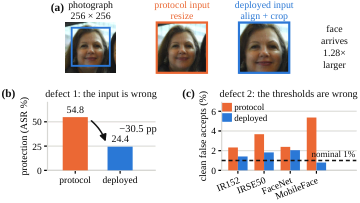
A standard attack designed to transfer between recognition models lost 56% of its protection when the same files underwent realistic face alignment and cropping.
Our read
- Studied:
- Preprint: empirical study
Editor of record: Boris Djordjevic · Paperfoot
The empirical study re-evaluated published face-privacy methods, which alter photos to hinder recognition, against face-recognition models. Deployed systems locate faces, line them up using facial landmarks and crop them. Methods published since 2022 instead supplied whole photographs or face-detection boxes.
Reprocessing the same files reduced protection. The authors traced the problem to mismatched image resampling, not alterations lost outside the crop. Accounting for alignment when creating altered images largely removed that mismatch. Four inherited decision cutoffs also allowed false matches at rates of 2.3–5.4% on whole images, rather than the intended 1%; aligned crops stayed near 1%. Differences between success rates obscured the size of the processing effect. The authors instead used a comparison of face-similarity scores in which the decision cutoffs cancel.
Why it matters
Tests on unchanged files showed that reported privacy protection depended on how images reached the recognition model—not just on the alterations made to them.
Caveats
The evaluation examined three unseen recognition models and one commercial system, and optimizing through alignment left a residual on one of them. The paper is a preprint.
From the paper
- Limitation
For impersonation there is no protocol drop at calibrated thresholds: AMT-GAN’s K_{1} is indistinguishable from zero and DiffAM’s positive, and our DiffAM runs stay below the published level ( 31.6 against 75.79 ), a gap its five reference makeups close only 15\% of.
Quoted word for word from the full text on arXiv.
In this paper
adversarial facial privacy evaluation
- Methods
- MI-FGSM (baseline)allocation-based attack (baseline)TI-FGSM (baseline)TIP-IM (baseline)Adv-CPG (baseline)DiffAM (baseline)AMT-GAN (baseline)IR152IRSE50FaceNetMobileFace
- Datasets
- FFHQ (evaluated)CelebA-HQ (evaluated)LADN (evaluated)
- Links
- Code
Results
- allocation-based attack, protection, deployed pipeline: 98.2; MI-FGSM, protection, deployed pipeline: 74.6
On these four recognizers the loss is removed, not merely reduced: under the deployed pipeline the allocation-based attack rises from 86.0 to 98.2, above its own protocol-pipeline number, and MI-FGSM from 24.4 to 74.6.
VII-B Main result
- TIP-IM, score, P_{\mathrm{dir}}: 17.8; TIP-IM, score, P_{\mathrm{ali}}: 42.9; TIP-IM, K_{1}: +25.2 pp
… TIP-IM scores 17.8 under P_{\mathrm{dir}} and 42.9 under P_{\mathrm{ali}}, so K_{1}={\color[rgb]{0.332,0.6602,0.4063}+25.2 pp} [+22.6, +27.8], positive on every target ( +13.6 to +40.6, each p<10^{-7 …
VII-C Published methods
- allocation-based attack, gap, on FFHQ: -0.063; allocation-based attack, gap, on CelebA-HQ: -0.075; allocation-based attack, gap, on LADN: -0.011
Its gap is -0.063 on FFHQ and -0.075 on CelebA-HQ, whose mismatches are 1.28 and 1.31, and -0.011 on LADN, whose mismatch is 1.10: a factor of six between the matched and the mismatched framing, with non-overlapping intervals.
III-F When does the gap appear?
- MI-FGSM, gap: -0.134; MI-FGSM, gap: -0.126; MI-FGSM, gap: -0.112
Its gap is -0.134, -0.126 and -0.112 on the same three datasets, a spread of 1.2× against the allocation attack’s 6×.
III-F When does the gap appear?
- MI-FGSM, loss, half-pixel shift: 55.5 pp
Under the half-pixel shift MI-FGSM loses 55.5 pp on IR152 [-62.5, -48.5], 44.5 – 52.0 on IRSE50 and MobileFace and 11.0 on FaceNet; rotation costs it 31.5 – 36.0 on the first three.
The sampling grid, at fixed scale
What it shows
- Re-scoring published face-privacy protections through a realistic front end costs a standard transfer attack 56% of its dodging protection and a budget-allocating attack 7% without regenerating images.
Re-scoring the same files through a realistic front end costs a standard transfer attack 56% of its dodging protection and a budget-allocating attack 7%, with no image regenerated.
Abstract
- The input defect causing the drop under a deployed front end is a resampling mismatch rather than perturbation lost outside the crop.
The cause is a resampling mismatch, not perturbation lost outside the crop; optimising through a differentiable alignment operator largely removes it, adding +24 to +58 points on unseen recognizers and a commercial system, with a residual on one of them.
Abstract
- The four inherited threshold constants maintain false-accept rates near nominal 1% on aligned crops but allow 2.3-5.4% on whole images.
The thresholds are wrong: the four constants inherited since 2021 hold the false-accept rate near its nominal 1% on aligned crops but admit 2.3-5.4% on whole images, with an opposite-signed bias across dodging and impersonation, the two tasks reported side by side.
Abstract
- The direct whole-image protocol misranks transfer attacks by deflating the one surveyed method that aligns at evaluation.
The protocol does not merely inflate: it misranks, deflating the one method that built the realistic front end; the half-pixel shift, applied on the aligned side, confirms the grid lock (supplement).
VII-C Published methods
- For impersonation there is no protocol drop at calibrated thresholds, with AMT-GAN showing a drop indistinguishable from zero.
For impersonation there is no protocol drop at calibrated thresholds: AMT-GAN’s K_{1} is indistinguishable from zero and DiffAM’s positive, and our DiffAM runs stay below the published level ( 31.6 against 75.79 ), a gap its five reference makeups close only 15% of.
Limitations
Quoted word for word from the full text on arXiv.
The paper
Wrong Input, Wrong Threshold: Re-evaluating Adversarial Facial Privacy
arXiv, Nov 16, 2026, Open access, Preprint, not yet peer-reviewed
doi.org/10.48550/arxiv.2611.21923
arXiv:2611.21923v1 in cs.CV, also cs.CR, cs.LG
Comments: 10 pages main text and 15 pages supplementary material. Submitted to IEEE Transactions on Information Forensics and Security. This work has been submitted to the IEEE for possible publication. Copyright may be transferred without notice, after which this version may no longer be accessible
Cite as BibTeX
@misc{parlayc2026wrong,
  title = {Wrong Input, Wrong Threshold: Re-evaluating Adversarial Facial Privacy},
  author = {Parlayıcı, Tunahan and Aptoula, Erchan and Saygın, Yücel},
  year = {2026},
  eprint = {2611.21923},
  archivePrefix = {arXiv},
  primaryClass = {cs.CV},
  doi = {10.48550/arxiv.2611.21923},
  url = {https://arxiv.org/abs/2611.21923}
}