A language model improved by changing its own internal values
One edit raised accuracy by 6.6 percentage points over the unchanged model on 490 unseen problems in a test fixed in advance.
Our read
- Studied:
- Preprint: method
Editor of record: Boris Djordjevic · Paperfoot
The preprint introduced self-rewriting, a method that let a language model change its own weights—the numerical values governing its responses—and improve accuracy on 490 previously unseen problems. The model contained 27 billion parameters. Given access to its weights, graded answers and the ability to run itself, it diagnosed failures and edited those values without additional training.
One edit raised accuracy by 6.6 percentage points over its unchanged version on a test fixed in advance. Across its first eight sessions, accuracy only rose; the model submitted an edit only when its own tests supported it. The changes persisted without adding computing cost per answer. The process required hours on one graphics chip.
Why it matters
The test demonstrated that this model could retain an accuracy improvement in its weights without another training run or extra computation for each answer.
Caveats
The abstract does not identify the 490-problem test or report the starting accuracy. Success also depended on scale: within the tested model family, smaller versions either made no edit or broke themselves.
In this paper
language model self-rewriting of weights
- Methods
- self-rewriting (this paper)Qwen3.5 2B (evaluated)
- Datasets
- DeepScaleR (training)MATH-500 (evaluated)AIME 2024 (evaluated)HMMT February 2025 (evaluated)AMC 2023 (evaluated)OlympiadBench (evaluated)GPQA-Diamond (evaluated)ScreenSpot-v2 (evaluated)MathVista (evaluated)MathVerse (evaluated)
What it shows
- A 27B open language model can rewrite its own weights to make itself better without gradients, training, or separate infrastructure, with the ability emerging with scale.
A 27B open language model can rewrite its own weights to make itself better, and the ability to do so emerges with scale.
5 Conclusion
- Under identical tasks and tools, smaller models fail to improve or break themselves, while only the 27B model successfully self-edits and repairs damage.
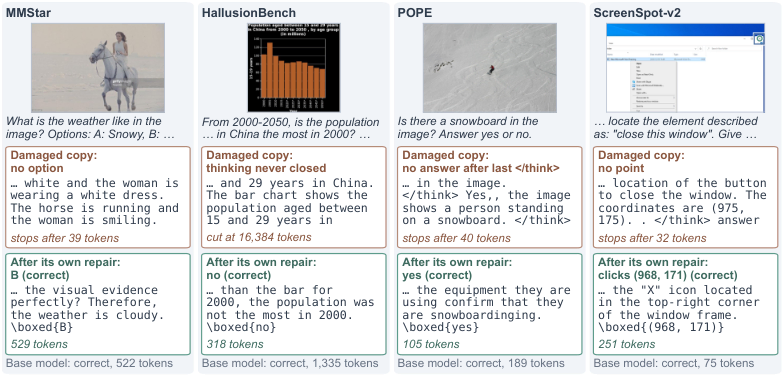
Across one model family at 2B, 4B, 9B and 27B parameters, under the same task and tools, the 2B model makes no edit and the 4B and 9B models break themselves; only the 27B model improves itself and repairs its damaged copy (figures 4 and 2).
1 Introduction
- A self-directed repair discovered entirely on text math problems restores performance on held-out image tasks to 83% of the base model's accuracy.
Found on text math problems alone, the repair also restores the copy on image tasks it never saw, with no pre-training or post-training, to 83% of the base model’s accuracy, and on ScreenSpot-v2 from 0% to 89%, against 93% for the base model (figures 2, 4, 5 and 12).
1 Introduction
- At the full token budget shared across sizes, the 27B model still advances further through self-rewriting steps before withdrawing its edit, whereas smaller models break themselves or make no edit.
At 16,384 tokens the 2B model makes no edit, the 4B and 9B models break themselves, and the 27B model tests its edit and withdraws it (tables 2 and 6).
3.8 Only at Scale
Quoted word for word from the full text on arXiv.
The paper
Language Models Can Rewrite Their Own Weights
arXiv, Nov 16, 2026, Open access, Preprint, not yet peer-reviewed
doi.org/10.48550/arxiv.2611.21885
arXiv:2611.21885v1 in cs.AI
Cite as BibTeX
@misc{fan2026language,
  title = {Language Models Can Rewrite Their Own Weights},
  author = {Fan, Jiajun and He, Neil and Yang, Changyi and Mao, Andy and Zhu, Xi and Cheng, Chaoran and Liang, Kaiqu and Shen, Shuaike and Li, Zetian and Guo, Ruihan and Liu, Ge},
  year = {2026},
  eprint = {2611.21885},
  archivePrefix = {arXiv},
  primaryClass = {cs.AI},
  doi = {10.48550/arxiv.2611.21885},
  url = {https://arxiv.org/abs/2611.21885}
}