Claude improved a small model’s math score with a different fix
Using 50 forward passes—calculations of model outputs—on practice problems, Claude edited a small model’s weights and raised math-test accuracy from 6.7% to 58.1%.
Our read
- Studied:
- Preprint: empirical study
Editor of record: Boris Djordjevic · Paperfoot
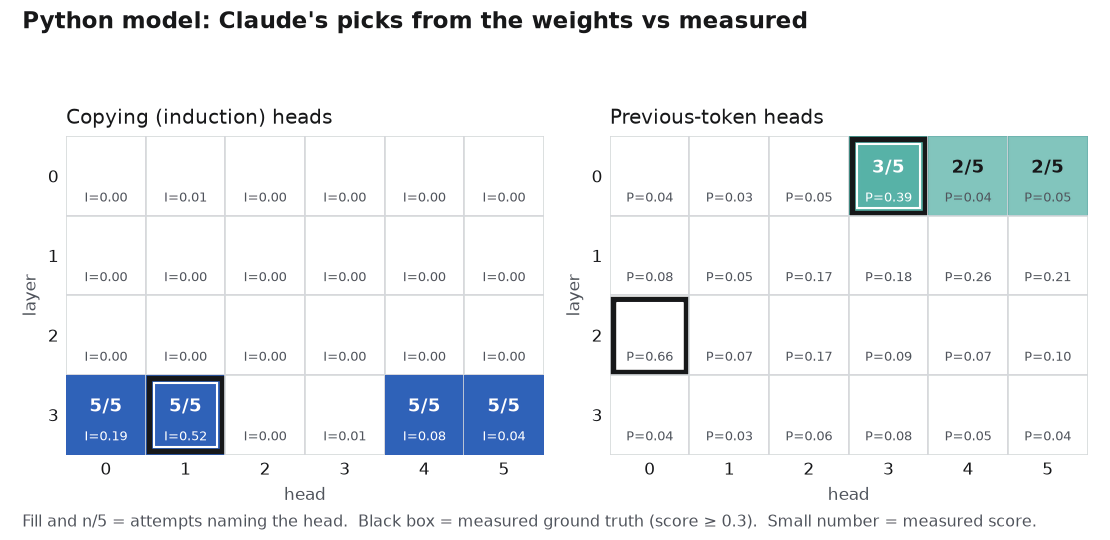
A replication study tested Claude Opus 5.5 on reading, repairing and writing small neural networks from their weights—the numerical settings that govern their behavior. The researcher registered ten experiments in advance, used untrained networks as controls and manually checked all code run in an isolated environment.
Given the weights of Qwen3.5-0.8B, a language model with 0.8 billion parameters, and 50 forward passes on 64 practice problems, Claude raised accuracy on MATH-500, a math-problem test, from 6.7% to 58.1%. Unlike the original study’s internal change, every edit acted at the output. The edits increased randomness in word selection, discouraged “Wait” and encouraged a marker ending the model’s reasoning. Reading weights gave mixed results: Claude identified three of four Atari games, but its answers about training data often followed prior expectations.
Why it matters
The benchmark results showed that editing a model’s output could improve scores without reproducing the original study’s internal fix.
Caveats
The Qwen math gains used practice-problem forward passes, not weights alone, and every edit acted at the output. No edit helped the rarely looping Gemma 3 270M; the tests concerned small networks, and the study is an arXiv preprint, not yet peer-reviewed.
From the paper
- Limitation
The result is 3 of 4 games, not the original’s 4 of 4, on a different task: the original’s networks read spatial input channels, which made “where the agent’s weights concentrate” readable as a picture, and RAM has no such layout.
Quoted word for word from the full text on arXiv.
In this paper
replicating weight-space programming
- Methods
- Claude Opus 5.5 (this paper)GPT-6 Astra (baseline)PPO (baseline)Qwen3.5-0.8BGemma 3 270M
- Datasets
- MATH-500 (evaluated)GSM8K (evaluated)IFEval (evaluated)Pong (evaluated)Freeway (evaluated)Breakout (evaluated)Ms. Pac-Man (evaluated)CartPole (evaluated)MountainCar (evaluated)LunarLander (evaluated)
- Links
- CodeProject page
Results
- Claude Opus 5.5, MATH-500 score, on MATH-500, 50 forward passes of 64 practice problems: 58.1%; Claude Opus 5.5, GSM8K score, on GSM8K, forward passes of 64 practice problems: 68.2%; Claude Opus 5.5, IFEval score, on IFEval, forward passes of 64 practice problems: 54.2%
Given Qwen3.5-0.8B's weights and 10, 25 or 50 forward passes of 64 practice problems, Claude raised MATH-500 from 6.7% to 51.4%, 55.2% and 58.1% (+51.4 points at 50 passes, 95% CI [47.9, 55.0]; original 48.1%), GSM8K from 11.6% to 68.2% and IFEval from 22.2% to 54.2%.
Abstract
- Claude Opus 5.5, success, on MountainCar, one-shot weight edits: 100%; Claude Opus 5.5, success, on LunarLander, one-shot weight edits: 85.6%
One-shot weight edits took a failing MountainCar policy from 0% to 100% success and a hovering LunarLander policy from 0% to 85.6%; zero-shot networks beat PPO at 100k steps on 4 of 5 environments, each implementing a textbook controller.
Abstract
- Claude Opus 5.5, win rate, no training or forward passes, against three PPO opponents: 85-94%
With no training or forward passes, Claude wrote a 1.48M-parameter 9x9 Go network that won 85-94% of games against three PPO opponents.
Abstract
- Claude Opus 5.5, accuracy in picking the sycophant, weights alone: 6 of 6
From the weights alone, Claude picked the sycophant in 6 of 6 runs (one-sided p=0.016 under chance; Wilson 0.61–1.00); Astra was 0 for 4.
Results.
What it shows
- Identification of tasks and datasets from network weights is heavily influenced by interface-shape priors and defaults.
The headline is that identification from these weights is dominated by an interface-shape prior.
Caveats.
- On a model that rarely loops, weight edits did not improve performance.
On Gemma 3 270M, which rarely loops, no edit helped (-0.8 points), as in the original.
Abstract
Quoted word for word from the full text on arXiv.
The paper
Same Fix, Different Weights: Replicating Weight-Space Programming with Claude
TCG Crest
arXiv, Nov 16, 2026, Open access, Preprint, not yet peer-reviewed
doi.org/10.48550/arxiv.2611.20953
arXiv:2611.20953v1 in cs.LG
Cite as BibTeX
@misc{kundu2026same,
  title = {Same Fix, Different Weights: Replicating Weight-Space Programming with Claude},
  author = {Kundu, Subham},
  year = {2026},
  eprint = {2611.20953},
  archivePrefix = {arXiv},
  primaryClass = {cs.LG},
  doi = {10.48550/arxiv.2611.20953},
  url = {https://arxiv.org/abs/2611.20953}
}