Theory checks quantum circuits for vanishing training signals
The researchers proved bounds on variation in training signals and developed an algorithm that could assess it from circuit runs when those bounds were inconclusive.
Our read
- Studied:
- Preprint: theory
Editor of record: Boris Djordjevic · Paperfoot
The researchers developed an analytical framework and a sampling algorithm to assess barren plateaus in quantum circuits, where signals used to adjust a circuit shrink exponentially as it grows. The framework bounded gradient variance—how much those signals vary—for arbitrary starting states and measured quantities.
Under specified randomness conditions, the framework gave the variance exactly. The researchers also proved structural conditions under which it stayed above a bound that shrinks only as a power of circuit size. Their sampling algorithm estimated the variance from circuit runs without constructing the mathematical projections used in the analysis. It determined whether the variance exceeded a chosen tolerance, with the required runs growing at most as a power of the inverse tolerance. This included cases where the analytical bounds were inconclusive.
Why it matters
The proof identified conditions that avoid one obstacle to training quantum circuits. The sampling algorithm offered a way to check a chosen variance threshold before committing to training.
Caveats
The guarantee required randomness conditions and sufficient concentration of paired copies of the input and measured quantity in the same mathematical component, whose dimension grew only as a power of circuit size; the adjusted gate also had to move that component by an inverse-power amount. This was a theoretical preprint, not a demonstration of successful training.
In this paper
answering whether a given quantum circuit has a barren plateau
- Methods
- sampling algorithm (this paper)Algorithm 1 (this paper)
What it shows
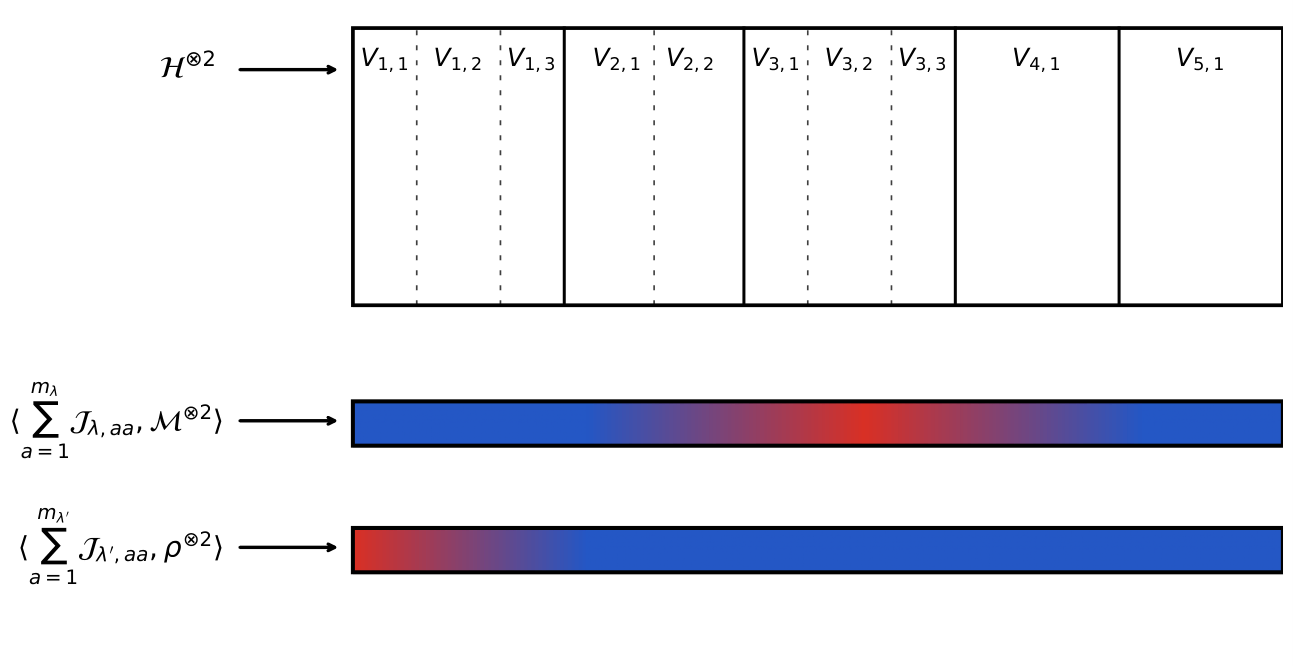
- When circuit segments on both sides of a gate form 2-designs, gradient variance can be obtained exactly from a representation decomposition.
When the circuit segments on both sides of a gate form 2-designs, we obtain the variance exactly and prove a sufficient condition for trainability: if ρ^(otimes 2) and M^(otimes 2) are sufficiently concentrated on the same irreducible invariant subspace of polynomial dimension, and the differentiated gate moves this subspace by an inverse-polynomial amount, then the gradient variance is at least inverse-polynomial …
Abstract
- An inverse-polynomially large upper bound does not by itself rule out a barren plateau because the bound evaluates state and measurement contributions independently.
An exponentially vanishing upper bound certifies a barren plateau, but an inverse-polynomially large upper bound does not by itself rule one out.
Why the upper bound cannot be inverted
- The sampling algorithm determines whether the gradient variance exceeds a tolerance τ using a number of circuit runs polynomial in 1/τ.
Our algorithm decides whether the variance exceeds a tolerance τ with the number of runs polynomial in 1/τ, including cases in which the bounds are inconclusive.
Abstract
- Algorithm 1 provides an unbiased estimate of the approximate finite-difference variance.
Algorithm 1 provides an unbiased estimate of the approximate variance {\mathbb{V}}_{\mathrm{FD}}.
Lemma 2.1.
Quoted word for word from the full text on arXiv.
The paper
Structure makes quantum circuits trainable
arXiv, Nov 13, 2026, Open access, Preprint, not yet peer-reviewed
doi.org/10.48550/arxiv.2611.18378
arXiv:2611.18378v1 in quant-ph, also cs.LG
Comments: 83 pages, 4 figures
Cite as BibTeX
@misc{xie2026structure,
  title = {Structure makes quantum circuits trainable},
  author = {Xie, Wenbo and Szpankowski, Wojciech and Grama, Ananth},
  year = {2026},
  eprint = {2611.18378},
  archivePrefix = {arXiv},
  primaryClass = {quant-ph},
  doi = {10.48550/arxiv.2611.18378},
  url = {https://arxiv.org/abs/2611.18378}
}

