Tuning outweighed quantum–classical gaps in classification tests
Tuning data scaling raised accuracy by 0.120 on synthetic data and 0.339 on real data, exceeding every measured quantum–classical difference.
Our read
- Studied:
- Preprint: empirical study
Editor of record: Boris Djordjevic · Paperfoot
An empirical study compared quantum and classical kernel methods for classification on synthetic data and four standard datasets. Kernel methods classify data by similarity; quantum kernels calculate similarity using quantum operations.
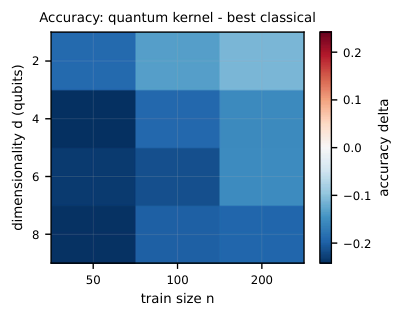
Both approaches received equal tuning budgets, and preprocessing and kernel calculations were repeated separately for each train-and-test split. The synthetic tests covered 324 combinations of data conditions. Tuning data scaling improved accuracy more than any measured quantum–classical difference. On all four real datasets, tuned quantum kernels were statistically indistinguishable from a tuned radial basis function kernel, a conventional method for measuring similarity. The synthetic-data advantage lay almost entirely in data generated by the quantum feature map, the rule used to encode data for quantum calculations.
Why it matters
The controlled classification tests separated tuning gains from differences between quantum and conventional methods. The authors concluded that variation in testing procedures was sufficient to explain the field’s contradictory findings.
Caveats
The real-data comparison covered four datasets, and the abstract does not report uncertainty ranges. This is an arXiv preprint, not yet peer-reviewed.
From the paper
- Limitation
One QPU latency figure feeds the cost extrapolation; no results were produced on a real device.
Quoted word for word from the full text on arXiv.
In this paper
quantum machine learning on classical data
- Methods
- SVMs with linear, polynomial and RBF kernels (baseline)histogram gradient boosting (baseline)fidelity kernel (evaluated)projected kernel (evaluated)
- Datasets
- Iris (evaluated)Wine (evaluated)Breast Cancer Wisconsin (evaluated)Ionosphere (evaluated)
- Links
- Code
Results
- fidelity kernel, accuracy, on synthetic data: 0.120; fidelity kernel, accuracy, on real data: 0.339
The dominant effect we measure is not quantum: tuning the feature map's bandwidth is worth 0.120 accuracy on synthetic data and 0.339 on real data, exceeding every quantum-classical difference we observe.
Abstract
- fidelity kernel, accuracy, per qubit: -0.0045
The advantage on synthetic data is confined almost entirely to data generated by the feature map itself, and it shrinks with dimensionality (-0.0045 per qubit) while growing with sample size.
Abstract
- fidelity kernel, circuits, at n = 10,000: 5×10⁷
Finite sampling costs an order of magnitude more accuracy than gate and readout noise, and a fidelity kernel needs 5×10⁷ circuits at n = 10,000.
Abstract
- fidelity kernel, circuits, at n=10,000: 49,995,000
At n=10,000 a fidelity kernel needs 49,995,000 circuits; at a measured 0.1 s per circuit that is about 1,389 hours, or 58 days of QPU time for a single kernel matrix.
V.6 Cost (H5, RQ3)
- projected kernel, accuracy, over 324 paired Tier A cells: 0.719
The projected kernel needs 400 × fewer circuits at half the depth, at a small but real accuracy cost: over 324 paired Tier A cells it averages 0.719 against the fidelity kernel’s 0.732, a deficit of 0.013 that is significant (Wilcoxon signed-rank, p = 8.9 \cdot 10-6) though small in effect size (paired Cohen’s d = -0.29 …
V.6 Cost (H5, RQ3)
What it shows
- Tuning the quantum feature map's bandwidth is the dominant experimental factor, producing an accuracy gain of 0.120 on synthetic data and 0.339 on real data.
The dominant effect we measure is not quantum: tuning the feature map's bandwidth is worth 0.120 accuracy on synthetic data and 0.339 on real data, exceeding every quantum-classical difference we observe.
Abstract
- Tuned quantum kernels are statistically indistinguishable from a tuned classical RBF kernel across all four evaluated real datasets.
Tuned quantum kernels are then statistically indistinguishable from a tuned RBF on all four real datasets.
Abstract
- Finite sampling costs an order of magnitude more accuracy than gate and readout noise, making the shot budget the binding constraint on quantum kernels.
Finite sampling costs an order of magnitude more accuracy than gate and readout noise, and a fidelity kernel needs 5×10⁷ circuits at n = 10,000.
Abstract
- Quantum kernel advantage on synthetic data is largely confined to data generated by the feature map itself and shrinks with dimensionality while growing with sample size.
The advantage on synthetic data is confined almost entirely to data generated by the feature map itself, and it shrinks with dimensionality (-0.0045 per qubit) while growing with sample size.
Abstract
- An untuned quantum kernel scores 0.617 accuracy on real data compared to 0.956 when tuned on identical circuits and data.
An untuned quantum kernel scores 0.617 on real data and a tuned one 0.956, on identical circuits and identical data.
I Introduction
Quoted word for word from the full text on arXiv.
The paper
arXiv, Oct 30, 2026, Open access, CC BY, Preprint, not yet peer-reviewed
doi.org/10.48550/arxiv.2610.42029
arXiv:2610.42029v1 in quant-ph, also cs.LG
Cite as BibTeX
@misc{bhalgami2026empirical,
  title = {Empirical Evaluation of Quantum Kernel Methods for Classification: A Comparative Study with Classical Kernels},
  author = {Bhalgami, Ronak},
  year = {2026},
  eprint = {2610.42029},
  archivePrefix = {arXiv},
  primaryClass = {quant-ph},
  doi = {10.48550/arxiv.2610.42029},
  url = {https://arxiv.org/abs/2610.42029}
}
