Hardware attacks weaken Windows Hello PIN guessing limits
On locked, encrypted hardware, the setup found a four-digit Windows Hello PIN in 40 hours instead of 69 days.
Our read
- Studied:
- Preprint: empirical study
Editor of record: Boris Djordjevic · Paperfoot
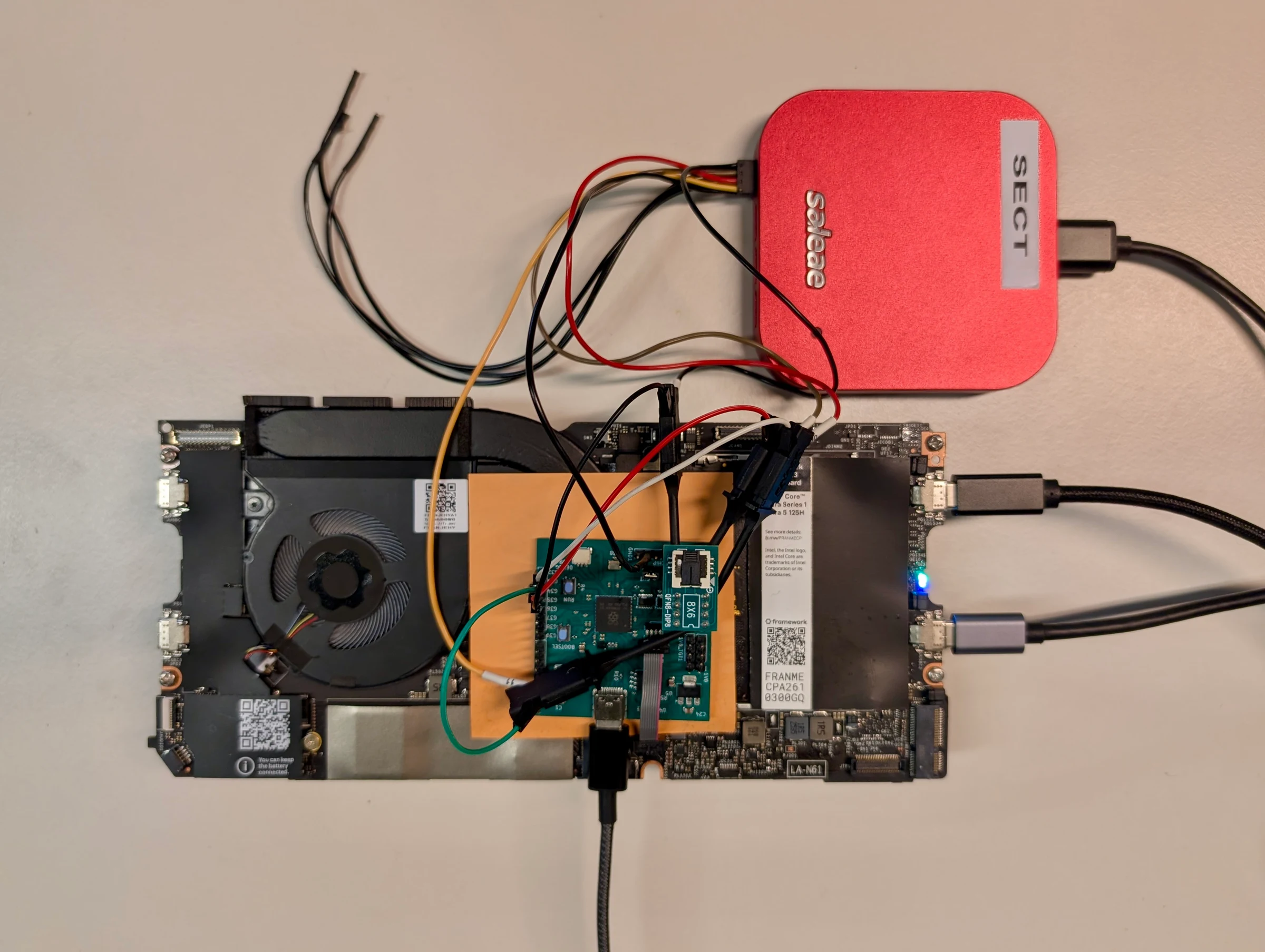
The security study tested replay-protected monotonic counters—flash-chip safeguards against restoring old security data—in commercially sold computers using low-cost hardware connected between components. These safeguards protect stored security data, including the lockout state that limits repeated Windows Hello PIN guesses.
Winbond flash memory leaked a secret authentication key when its voltage was briefly disrupted, allowing forged counter values. AMD’s controller failed to verify counter increases, allowing the connecting hardware to suppress them unnoticed. Restoring earlier security data let the setup find a four-digit Windows Hello PIN on locked, encrypted hardware in 40 hours instead of 69 days.
Why it matters
The hardware demonstration showed that restoring old security data could undermine the guessing limits that make short Windows Hello PINs viable.
Caveats
The attacks involved physical hardware access; the abstract does not specify how broadly the two main flaws were tested across devices. The paper is a preprint, not yet peer-reviewed.
In this paper
security analysis of RPMC in shipping x86 systems
- Methods
- Replay Protected Monotonic Counters (RPMCs) (evaluated)
Results
- Replay Protected Monotonic Counters (RPMCs), time, on locked, encrypted hardware: 40 hours
We demonstrate this end-to-end on locked, encrypted hardware: our setup finds a 4-digit Windows Hello PIN in 40 hours instead of 69 days.
Abstract
- Replay Protected Monotonic Counters (RPMCs), worst-case time, BitLocker's TPM+PIN pre-boot protector, default-length 6-digit PIN: 20 days
The same primitive defeats BitLocker's TPM+PIN pre-boot protector, reducing the worst-case time for a default-length 6-digit PIN from 19 years to 20 days.
Abstract
What it shows
- Winbond SPI flash leaks its HMAC key under voltage glitching, allowing arbitrary counter forgery.
… First, Winbond SPI flash - the leading NOR flash vendor with over 25% market share - leaks its HMAC key under voltage glitching, enabling arbitrary counter forgery …
Abstract
- AMD's NV controller fails to verify RPMC increments, allowing an interposer to suppress them unnoticed.
Second, AMD's NV controller does not verify RPMC increments, so an interposer can suppress them unnoticed.
Abstract
- On AMD platforms lacking RPMC flash, reflashing an old image resets fTPM lockout counters.
Moreover, AMD platforms without RPMC flash appear to lack NV rollback protection altogether: on two AMD desktops, reflashing an old image resets the fTPM's lockout counters.
Abstract
- GigaDevice flash returns faulty counter values under voltage glitching during the Request Monotonic Counter process.
We found the GigaDevice flash to be susceptible to voltage glitching during the Request Monotonic Counter process.
3.2. Counter Corruption
Quoted word for word from the full text on arXiv.
The paper
Hello Again: Exploiting Replay Protected Monotonic Counters to Brute-Force Windows Hello PINs
arXiv, Nov 13, 2026, Open access, Preprint, not yet peer-reviewed
doi.org/10.48550/arxiv.2611.18126
arXiv:2611.18126v1 in cs.CR
Comments: This is a slightly updated version of the paper published at ACM CCS '26 (https://doi.org/10.1145/3830454.3846631). The section Changes from the CCS '26 Version lists all changes
Cite as BibTeX
@misc{werling2026hello,
  title = {Hello Again: Exploiting Replay Protected Monotonic Counters to Brute-Force Windows Hello PINs},
  author = {Werling, Christian and Finder, Matti and Jacob, Hans Niklas and Prein, Julian and Kühnapfel, Niclas and Seifert, Jean-Pierre},
  year = {2026},
  eprint = {2611.18126},
  archivePrefix = {arXiv},
  primaryClass = {cs.CR},
  doi = {10.48550/arxiv.2611.18126},
  url = {https://arxiv.org/abs/2611.18126}
}