A method led retrieval tests at extreme memory compression
Transformer-FSQ was the most accurate method tested across model sizes at 12-fold to 97.5-fold language-model memory compression, compared with five families of alternatives.
Our read
- Studied:
- Preprint: method
Editor of record: Boris Djordjevic · Paperfoot
Transformer-FSQ, a method for compressing language models’ memory of earlier text, led tests on RULER, a benchmark for retrieving information from long contexts. The researchers tested models with 0.6 billion to 8 billion parameters, the adjustable numbers in a model.
The method replaced the calculations that produce stored keys and values with finite scalar quantization, which represented numbers using a limited set of levels. It stored packed integer codes for each token—a unit of text—without separate per-token information describing the quantization. Converting pretrained models required training only those replacement calculations, using 0.25 tokens per original model parameter. At compression ratios from 12-fold to 97.5-fold, Transformer-FSQ was the most accurate method evaluated across model sizes, against five families of alternatives.
Why it matters
The benchmark results support compressing stored context as a way to increase how much text a fixed device can retain.
Caveats
The retrieval results do not establish broader language-model quality or performance on consumer devices. The work is an arXiv preprint, not yet peer-reviewed.
From the paper
- Limitation
High-dimensional product grids operate beyond initial low-dimensional validations.
Quoted word for word from the full text on arXiv.
In this paper
extreme KV-cache compression
- Methods
- Transformer-FSQ (this paper)QAFT-FSQ (this paper)FSQ-pre (this paper)FSQ-small (this paper)post-hoc FSQ (baseline)PyramidKV (baseline)KIVI (baseline)VecInfer (baseline)Palu (baseline)TransMLA (baseline)Qwen3-0.6B-BaseQwen3-8B-Base
- Datasets
- RULER (evaluated)LongBench (evaluated)gov_report (evaluated)ClimbMix (training)
- Links
- Code
Results
- Transformer-FSQ, ROUGE-L, on gov_report, at 32×: 12.5; Transformer-FSQ, ROUGE-L, on gov_report, at 97.5×: 11.4
In contrast, Transformer-FSQ scores highest from 32× to 97.5× on all three models; on Qwen3-8B-Base it scores 12.5 at 32× and 11.4 at 97.5×, where Palu at 102.4× scores 7.0.
5.2 Results
- QAFT-FSQ, RULER, on RULER, width of 160 and 4-bit precision: 0.177± 0.017
At the same width of 160 and 4-bit precision (scores: mean ± 95% bootstrap half-width), QAFT-FSQ achieves 0.177± 0.017 RULER, compared with 0.136± 0.014 for post-hoc FSQ.
5.2 Results
- Qwen3-8B-Base, RULER score, on RULER, 16-bit baseline: 0.913
The uncompressed model with 4-bit NF4 weights achieves a RULER score of 0.913 (within 0.010 of its 16-bit baseline of 0.922 ).
5.2 Results
- Transformer-FSQ, RULER score, on RULER, finetuned on the frozen NF4 backbone: 0.464
However, when finetuned on the frozen NF4 backbone, Transformer-FSQ recovers to 0.464 (95% bootstrap CI [0.444,0.485] ), recovering 74% of the loss from applying NF4 after finetuning and trailing the same model on the 16-bit backbone by only 0.029.
5.2 Results
- Transformer-FSQ, score, on RULER, on Qwen3-8B-Base: 0.49
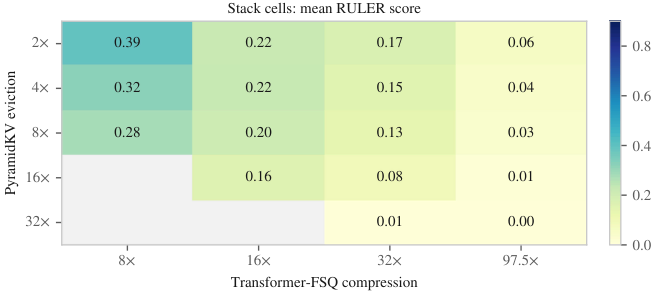
Beyond 12×, continuous latents and eviction collapse: Palu drops to 15% at 15.1×, while Transformer-FSQ outclasses token eviction by 0.12 at 12× and 0.10 at 32× on Qwen3-0.6B-Base, reaching 0.49 on Qwen3-8B-Base (a lead of 0.25; Table 11).
5.2 Results
- Transformer-FSQ, median throughput relative to native SDPA, at 32× on Qwen3-0.6B: 1.38×; Transformer-FSQ, median throughput relative to native SDPA: 1.34×; Transformer-FSQ, median throughput relative to native SDPA: 1.01×
Benchmarking on NVIDIA L40S GPUs (Figure 6) shows median throughput relative to native SDPA of 1.38×, 1.34× and 1.01× at 32× on Qwen3-0.6B, 1.7B and 8B, where the saved cache reads and the per-step key reconstruction approximately offset each other.
5.2 Results
- Transformer-FSQ, throughput relative to native SDPA, at 409.6× on Qwen3-0.6B: 1.98×; Transformer-FSQ, throughput relative to native SDPA, at 409.6× on Qwen3-1.7B: 2.20×; Transformer-FSQ, throughput relative to native SDPA, at 409.6× on Qwen3-8B: 1.63×
At extreme compression, memory bandwidth savings dominate arithmetic: 1.98×, 2.20× and 1.63× at 409.6×, and up to 5.86× on Qwen3-0.6B when the batch holds at least 100,000 tokens.
5.2 Results
What it shows
- Transformer-FSQ achieves the highest measured RULER accuracy from 12× to 97.5× compression and the highest gov_report ROUGE-L from 32× to 97.5× across Qwen3 models from 0.6B to 8B parameters.
Across Qwen3 models from 0.6B to 8B parameters, Transformer-FSQ achieves the highest measured RULER accuracy from 12× to 97.5× compression and the highest gov_report ROUGE-L from 32× to 97.5×.
7 Conclusion and future work
- Quantisation-aware finetuning of low-bit coordinates outperforms post-hoc quantisation on an inference-time grid under extreme compression at a fixed cache budget.
At the same width of 160 and 4-bit precision (scores: mean ± 95% bootstrap half-width), QAFT-FSQ achieves 0.177± 0.017 RULER, compared with 0.136± 0.014 for post-hoc FSQ.
5.2 Results
- Directly training the discrete KV bottleneck on top of frozen 4-bit weights recovers long-context retrieval to within 0.029 of the 16-bit backbone under joint 4-bit weight and 32× KV-cache compression.
Directly training the discrete KV bottleneck on top of frozen 4-bit weights confirms that Transformer-FSQ adapts to weight-quantised backbones, recovering long-context retrieval to within 0.029 of the same Transformer-FSQ model on the 16-bit backbone under joint 4-bit weight and 32× KV-cache compression …
5.2 Results
- The evaluation measures retrieval, tracking, and question answering on RULER at 8,192 tokens and three LongBench tasks, but does not test arithmetic reasoning, code generation, or many-shot in-context learning under compression.
Our long-context evaluation measures retrieval, tracking and question answering on RULER at one context length, 8,192 tokens, and three LongBench tasks on documents of up to 32,768 tokens; it does not test arithmetic reasoning, code generation or many-shot in-context learning under compression, where prior work reports sharper degradation than on retrieval-style tasks …
6 Limitations
Quoted word for word from the full text on arXiv.
The paper
Transformer-FSQ: Discrete Latents for Extreme KV-Cache Compression
arXiv, Nov 6, 2026, Open access, Preprint, not yet peer-reviewed
doi.org/10.48550/arxiv.2611.09598
arXiv:2611.09598v1 in cs.LG
Cite as BibTeX
@misc{szecsenyi2026transformerfsq,
  title = {Transformer-FSQ: Discrete Latents for Extreme KV-Cache Compression},
  author = {Szecsenyi, Andras and Lee, Thomas L. and Shaj, Vaisakh and Crowley, Elliot J. and Storkey, Amos},
  year = {2026},
  eprint = {2611.09598},
  archivePrefix = {arXiv},
  primaryClass = {cs.LG},
  doi = {10.48550/arxiv.2611.09598},
  url = {https://arxiv.org/abs/2611.09598}
}