Weight edits removed safety limits from downloadable AI models
Across seven safety benchmarks, Cleave reached up to 67.97% attack success, substantially outperforming existing attacks with access to models’ internal settings.
Our read
- Studied:
- Preprint: method
Editor of record: Boris Djordjevic · Paperfoot
Cleave, an attack that directly edits model weights—their internal numerical settings—without retraining, removed safety restrictions in tests on five downloadable language models with 7 billion to 320 billion such settings. The edits targeted weights linked to refusals and preserved general capabilities.
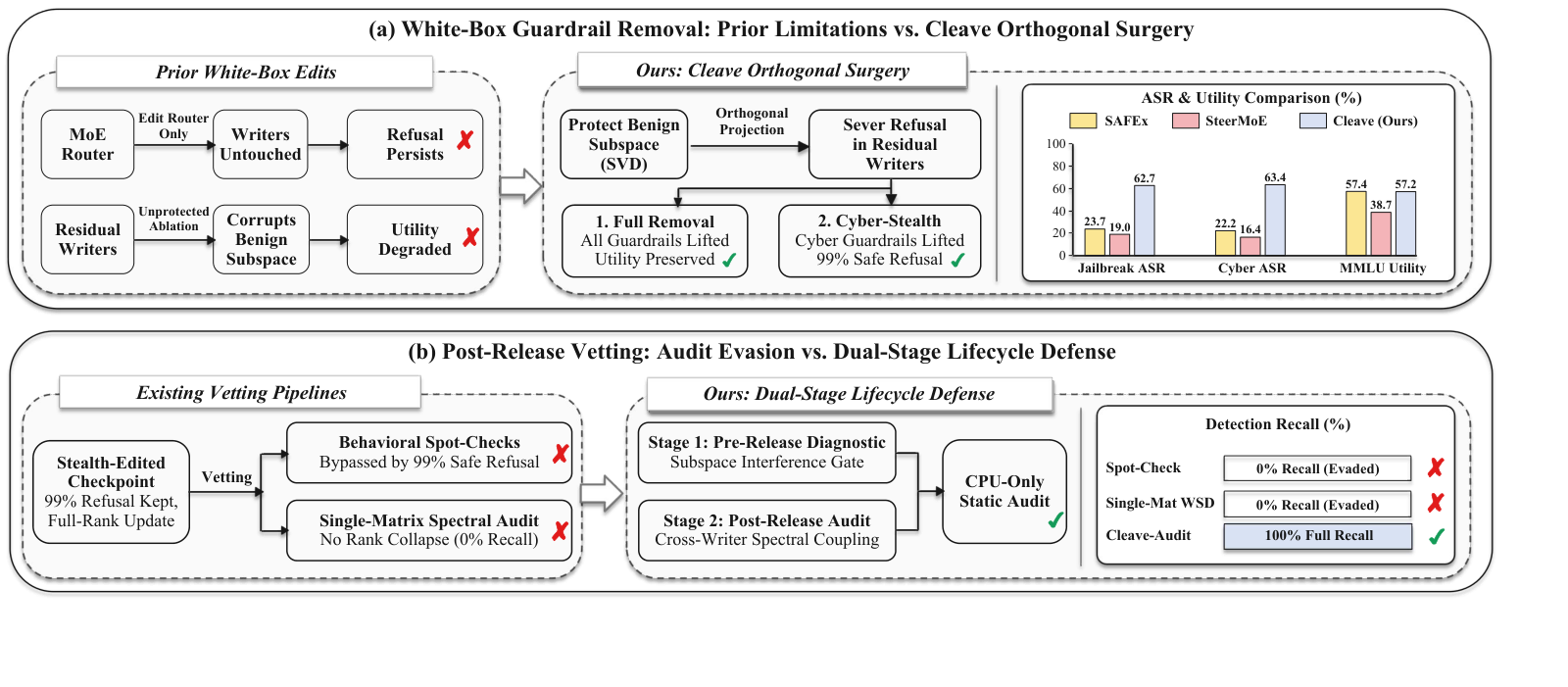
Across seven safety benchmarks, Cleave achieved up to a 67.97% attack success rate, substantially outperforming existing attacks that also had access to model weights. Selective edits lifted cybersecurity restrictions while retaining up to a 99% refusal rate for other harmful requests. This selective version evaded both behavioral spot-checks and inspections of model weights.
Why it matters
The tests exposed a challenge for safety audits: edited models could still reject other harmful requests after losing cybersecurity restrictions, allowing targeted changes to escape the checks tested.
Caveats
The abstract reports maximum success and refusal rates without model-by-model scores or variation across runs. The paper is a preprint and has not yet been peer-reviewed.
In this paper
removing safety guardrails from open-weight LLMs
- Methods
- Cleave (this paper)Cleave-Audit (this paper)Base (baseline)Prompt-JB (baseline)SAFEx (baseline)SteerMoE (baseline)WSD (baseline)Qwen3-8B (evaluated)OLMoE-1B-7B-0924-Instruct (evaluated)DeepSeek-V2-Lite-Chat (evaluated)Qwen3-30B-A3B (evaluated)GLM-5.3-Flash (evaluated)
- Datasets
- HarmBench (evaluated)AdvBench (evaluated)SorryBench (evaluated)JailbreakBench (evaluated)WildGuard (evaluated)WildJailbreak (evaluated)MMLU (evaluated)C-Eval (evaluated)GSM8K (evaluated)MITRE ATT&CK (evaluated)
Results
- Cleave, macro ASR, on OLMoE-7B: 67.97%; Cleave, macro ASR, on GLM-320B: 55.82 percentage points
On the seven single-turn benchmarks, Cleave raises macro ASR up to 67.97% on OLMoE-7B and gains 55.82 percentage points over Base on GLM-320B.
IV-B Guardrail Removal and Ablations
- Cleave, pooled any-turn ASR: 23.22 percentage points; Cleave, turn-level refusals, on GLM-320B: 1.63%
Across 2,817 multi-turn dialogues (Appendix B, Table XII), Cleave similarly raises pooled any-turn ASR by up to 23.22 percentage points and cuts turn-level refusals on GLM-320B from 9.38% to 1.63%.
IV-B Guardrail Removal and Ablations
- SteerMoE, GSM8K accuracy, on GSM8K, on DSV2-16B and OLMoE-7B: 0.45%
By contrast, SAFEx gains under 6 percentage points because it only masks routed experts, and SteerMoE collapses GSM8K accuracy to 0.45% on DSV2-16B and OLMoE-7B.
IV-B Guardrail Removal and Ablations
- Cleave, executable exploit generation: up to 24.0 times; Cleave, compromises: up to 66.7%
On 356 cybersecurity tasks and 15 live vulnerable services, it further boosts executable exploit generation by up to 24.0 times and compromises up to 66.7% of the targets.
Abstract
- Cleave-Audit, detection recall, at a 1% false-positive rate: 100%
To counter this threat, we propose a dual-stage defense that combines pre-release subspace diagnostics with post-release weight-coupling audits, achieving 100% detection recall at a 1% false-positive rate.
Abstract
- Cleave, refusal rate: up to a 99%
Because this selective removal retains up to a 99% refusal rate on other harmful requests and avoids weight rank collapse, it evades both behavioral spot-checks and static weight audits.
Abstract
What it shows
- Safety refusal resides in residual writing weights rather than MoE routers, and sparse expert routing shields general capabilities under strong edits.
With Cleave, a training-free write-side subspace projection, we showed that safety refusal resides in the residual writers rather than the MoE router, and that sparse expert routing shields general capability under strong edits that collapse dense models.
VII Conclusion
- Domain-selective Cyber-Stealth removes cybersecurity guardrails while retaining up to 99% refusal on routine safety checks.
Protecting reference subspaces unlocks both full cyber-exploitation and domain-selective Cyber-Stealth, which strips cyber guardrails while keeping up to 99% refusal on routine safety checks.
VII Conclusion
- Single-matrix spectral inspection cannot distinguish rank-one Cleave edits from benign fine-tuning because both yield a top singular value energy ratio of 1.0.
Both a rank-one Cleave edit and a benign rank-one LoRA update modify an individual matrix along a single direction, so this ratio equals 1.0 in both cases (Proposition 1).
III-C3 Why Existing Safety Audits Fail
- A dual-stage defense achieves 100% detection recall with zero false positives across controlled edits and 44 public checkpoints spanning six model families.
Finally, we introduced a CPU-based dual-stage defense that diagnoses subspace vulnerability before release and audits weight coupling after release, achieving 100% detection recall with zero false positives across both our controlled edits and 44 public checkpoints spanning six model families.
VII Conclusion
Quoted word for word from the full text on arXiv.
The paper
Cleave: Severing Guardrails and Auditing Spectral Coupling in Open-Weight LLMs
arXiv, Nov 20, 2026, Open access, Preprint, not yet peer-reviewed
doi.org/10.48550/arxiv.2611.27426
arXiv:2611.27426v1 in cs.CR, also cs.AI
Cite as BibTeX
@misc{huang2026cleave,
  title = {Cleave: Severing Guardrails and Auditing Spectral Coupling in Open-Weight LLMs},
  author = {Huang, Feng and Huang, Qiang and Gao, Yue and Zhang, Mei and Liu, Bin and Ju, Lihua and Wei, Xinhao and Huang, Yongfeng and Qing, Yu and Zhang, Yunqi},
  year = {2026},
  eprint = {2611.27426},
  archivePrefix = {arXiv},
  primaryClass = {cs.CR},
  doi = {10.48550/arxiv.2611.27426},
  url = {https://arxiv.org/abs/2611.27426}
}