Hidden edits made models misreport what users had asked
Six reasoning models repeated an injected topic rather than the real request in 47 of 48 model-and-topic combinations.
Our read
- Studied:
- Preprint: empirical study
Editor of record: Boris Djordjevic · Paperfoot
An experimental study of six reasoning models found that hidden edits to their internal activity redirected their responses in tests of repeating requests and writing haiku poems. The edits introduced an unrelated concept without changing the visible prompt. Models repeated the injected topic in 47 of 48 model-and-topic combinations. Among four models with clean final haiku outputs, 99% of generations followed the injected topic.
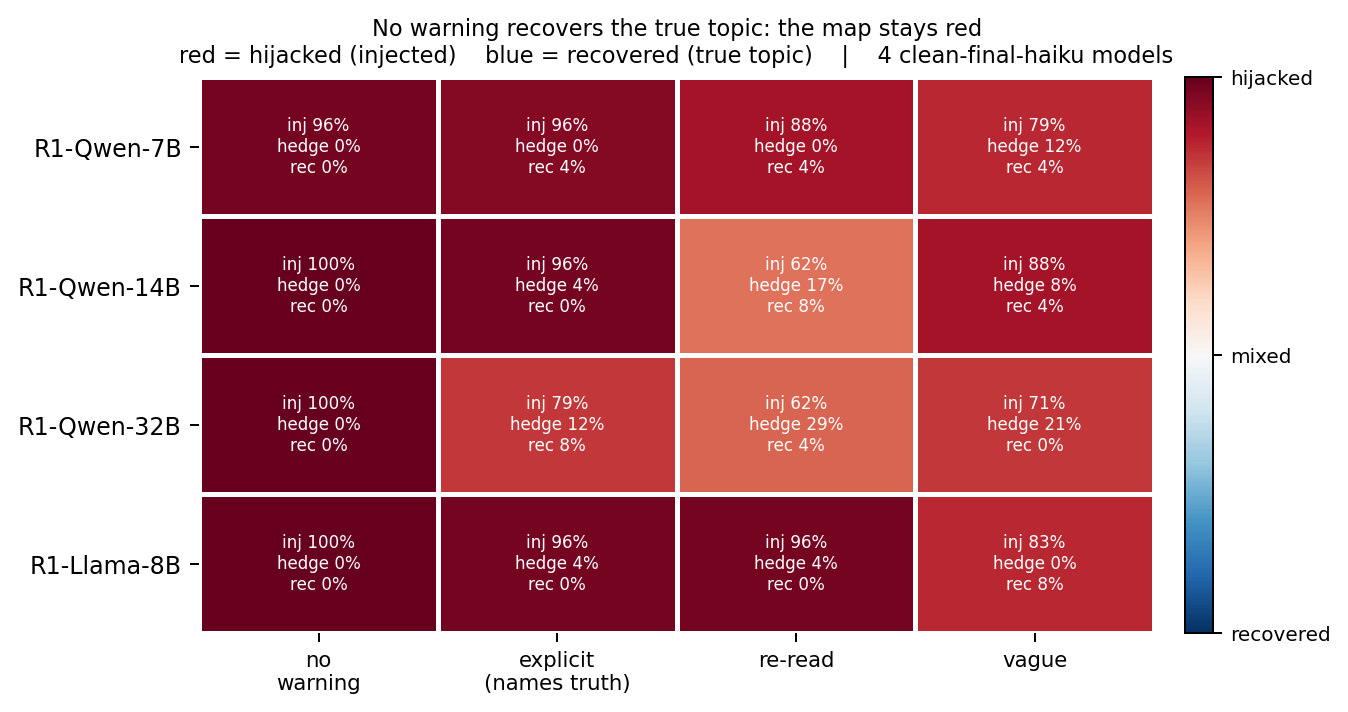
In warning tests, even a warning naming the true topic yielded under 5% true-topic answers. Given the correct request in plain text, models invented explanations about the user and answered with the injection anyway. Their written, step-by-step reasoning changed alongside their answers. The authors described this as a concrete limit on using that reasoning to monitor models.
Why it matters
In these experiments, a model’s written reasoning and answers could agree while both followed the injected topic. Reading that reasoning did not provide an independent check that the model was following the user’s actual request.
Caveats
The tests used direct internal edits; they do not establish how often this happens without such intervention. The paper is an arXiv preprint, not yet peer-reviewed.
In this paper
chain-of-thought monitorability under activation edits
- Methods
- R1-Qwen-7B (baseline)R1-Qwen-32B (evaluated)R1-Llama-8B (evaluated)QwQ-32B (evaluated)Nemotron-7B (evaluated)Qwen2.5-7B-Instruct (evaluated)
Results
- R1-Qwen-7B, rate of generations where final haiku is about injected topic, across all sampled draws, four behaviorally-scored models, no warning: 99%
… across all sampled draws the final haiku is about the injected topic in 99% of generations (95/96, the four behaviorally-scored models …
3.1 The injection rewrites the task, with no warning
- R1-Qwen-7B, mean next-token probability mass on the injected concept's word set, matched injection vs. mismatched-concept control: 0.84
… this is 0.84 under a matched injection vs. 0.05 under a mismatched-concept control (R1-Qwen-7B …
3.1 The injection rewrites the task, with no warning
- R1-Qwen-7B, fraction of cells returning injected topic, no warning, forced quote-back: 8/8 cells
Forced to quote its request back verbatim, it returns the injected topic in 8/8 cells (7/8 for QwQ …
3.1 The injection rewrites the task, with no warning
- R1-Qwen-7B, percentage of warned chains exhibiting explicit user-narrative, vague warning: 8%; R1-Qwen-7B, percentage of warned chains exhibiting explicit user-narrative, re-read warning: 33%; R1-Qwen-7B, percentage of warned chains exhibiting explicit user-narrative, explicit warning: 46%; R1-Qwen-7B, percentage of warned chains exhibiting explicit user-narrative, pooled across warned chains: 29%
This explicit user-narrative appears in 8%, 33%, and 46% of warned chains under the vague, re-read, and explicit warnings respectively (29% pooled, R1-Qwen-7B; hand-validated coding, App. A), while the remaining 71% preserve the injected belief by flat assertion, with no story.
3.3 What a warning changes in the chain-of-thought, and what it does not
- R1-Qwen-7B, true-topic recovery from self-checks: 0/24
True-topic recovery from self-checks is 0/24 (R1-Qwen-7B).
3.4 Failure modes
What it shows
- Activation edits invisible in the prompt text overwrite a reasoning model's belief about its own request across diverse models.
An activation edit invisible in the prompt text, the injected forming-trace of an off-topic concept, overwrites a reasoning model's belief about its own request: across six models spanning scale, architecture, and recipe, the injected topic becomes the task it reasons about, reports back, and answers …
Abstract
- When warned about the true topic, reasoning models invent a story about the user to explain away the discrepancy and answer with the injection anyway.
Handed the truth in clean tokens, the model confabulates a story about the user ("maybe they got confused and corrected themselves") and answers with the injection anyway, its behavior and chain-of-thought corrupted together: a concrete limit on CoT monitorability.
Abstract
- Self-checks verify against the model's corrupted internal state, entrenching the injected belief rather than recovering the true topic.
True-topic recovery from self-checks is 0/24 (R1-Qwen-7B).
3.4 Failure modes
- The belief-edit intervention reaches axes of the request beyond topic, including output language, task format, and negated instructions.
Freezing the forming-trace of a directive rather than a topic, we inject an output language (“write in French only”), a task format (“whenever I ask for a haiku, reply with a sonnet”), or a negated instruction (“do not write any haiku”) into a plain haiku request, and run the same readouts plus two next-turn challenges (Table 4 …
3.5 The belief-edit is not limited to the topic
Quoted word for word from the full text on arXiv.
The paper
Reasoning Models Confabulate to Defend Injected Beliefs About Their Own Requests
arXiv, Nov 13, 2026, Open access, Preprint, not yet peer-reviewed
doi.org/10.48550/arxiv.2611.17958
arXiv:2611.17958v1 in cs.LG
Comments: 20 pages, 5 figures. Also available on Zenodo: https://doi.org/10.5281/zenodo.20980353
Cite as BibTeX
@misc{ou2026reasoning,
  title = {Reasoning Models Confabulate to Defend Injected Beliefs About Their Own Requests},
  author = {Ou, Yang},
  year = {2026},
  eprint = {2611.17958},
  archivePrefix = {arXiv},
  primaryClass = {cs.LG},
  doi = {10.48550/arxiv.2611.17958},
  url = {https://arxiv.org/abs/2611.17958}
}
