HyperSSM solves group tasks in sequence-tracking benchmarks
HyperSSM solved sequence-tracking tasks exactly with at most five numbers representing its state, including one where previous state space models performed at chance.
Our read
- Studied:
- Preprint: new model
Editor of record: Boris Djordjevic · Paperfoot
HyperSSM, a new state space model that updates a stored state as inputs arrive, solved the mathematical group tasks in recent sequence-tracking benchmarks exactly. These tasks involve sequences of operations governed by mathematical rules. The model learned from final answers alone and needed at most five numbers to represent its state.
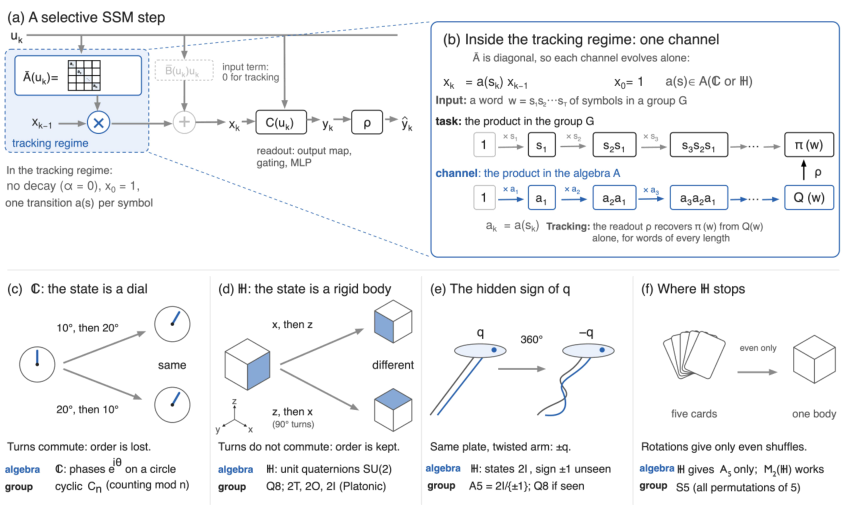
The researchers’ mathematical analysis explained why common state updates lose information about input order. HyperSSM added channels based on quaternions, a four-part number system, while keeping processing time proportional to sequence length and allowing parallel training. One task involved sequences drawn from 32 operations that rearrange five objects; previous state space models performed at chance. HyperSSM also generalized to sequences 25 times longer than those used in training.
Why it matters
The benchmark results showed that very small stored states could track mathematical operations whose order matters. The theory also let the authors interpret the learned memory updates directly.
Caveats
The exact-solving claim concerns mathematical group benchmarks, not general language performance. The abstract did not report variation across runs; the work is a preprint.
In this paper
state tracking in state space models
- Methods
- HyperSSM (this paper)PD-SSM (baseline)Gated DeltaProduct (baseline)LSTM (baseline)S4DLRUMamba-1Mamba-2
- Datasets
- BROAD (evaluated)Protein Data Bank (evaluated)
Results
- PD-SSM, accuracy, S5 with 32 generators: 1.07%; Gated DeltaProduct, accuracy, S5 with 32 generators: 1.23%
For S_{5} with 32 generators, PD-SSM (128 complex numbers) achieves 1.07% accuracy, and Gated DeltaProduct achieves 1.23%, which is near chance level (0.83%), while HyperSSM remains exact.
IV.1 Exact state tracking on benchmarks
- HyperSSM, accuracy, modular arithmetic: 99.3± 0.4%
For modular arithmetic, a dense M_{16}(\mathbb{C}) block achieves 99.3± 0.4% accuracy; although an exact memory solution for three numbers exists, it is not discovered through training (SM S9.1).
IV.1 Exact state tracking on benchmarks
- HyperSSM, drift, on BROAD, at 2 minutes: 26.5^{\circ}
HyperSSM matches gyroscope integration performance and exhibits reduced drift over extended time horizons ( 26.5^{\circ} compared to 30.9^{\circ} at 2 minutes), due to its ability to learn the sensor’s calibration [Fig. 4(a)].
IV.2.1 Rigid bodies: a real gyroscope
- HyperSSM, Bloch vectors deviation from the true values, for all sequence lengths up to 1000 gates: 10^{-3} degrees
HyperSSM achieves exact results in both cases: its Bloch vectors remain within 10^{-3} degrees of the true values for all sequence lengths up to 1000 gates, which is 25 times the training length.
IV.2.2 Qubits: simulating and characterizing gates
- LSTM, drift on Clifford+ T, at 1000 gates: about 6^{\circ}
An LSTM can model the finite Clifford group to within approximately 0.2^{\circ}, but exhibits drift on Clifford+ T, reaching about 6^{\circ} at 1000 gates.
IV.2.2 Qubits: simulating and characterizing gates
- HyperSSM, error, on Protein Data Bank, at 16 residues: 12.1^{\circ}; HyperSSM, error, on Protein Data Bank, at 64 residues: 23.7^{\circ}
HyperSSM is more accurate than reconstruction using standard bond geometry across all sequence lengths from 2 to 64 residues ( 12.1^{\circ} versus 14.4^{\circ} at 16, 23.7^{\circ} versus 26.5^{\circ} at 64; Fig. 4(c)), as it captures the average geometry of actual protein backbones.
IV.2.3 Proteins: the backbone as a chain of rotations
What it shows
- An SSM tracks a group at every sequence length if and only if that group is a quotient of the group generated by its transition matrices.
The state update defines a linear representation of the monoid of input sequences, and we show that an SSM tracks a group at every sequence length exactly when that group is a quotient of the group generated by its transition matrices.
Abstract
- Any channel over an algebra of dimension less than four can track only commutative groups.
A channel over an algebra of dimension less than four tracks only abelian groups.
Corollary 1.
- In the tracking regime, a stack of commutative layers with transitions in a compact group tracks a finite group if and only if the group is solvable of derived length at most the stack depth.
Such a stack tracks a finite group K if and only if K is solvable of derived length at most L.
Proposition 2 (Depth).
- The transition matrices of any SSM tracking a group decompose into independent blocks over the real, complex, and quaternion numbers.
Diagonal real- and complex-valued SSMs can track only commutative groups, while the transition matrices of any SSM that can track a group must split into independent blocks over the real, complex, and quaternion numbers.
Abstract
- HyperSSM maintains exact performance on group state tracking up to 25 times the sequence length seen during training.
HyperSSM maintains exact performance up to 25 times the training sequence length.
IV.1 Exact state tracking on benchmarks
Quoted word for word from the full text on arXiv.
The paper
Symmetry in Time: A Representation Theory of Linear Recurrent Memory
arXiv, Nov 12, 2026, Open access, Preprint, not yet peer-reviewed
doi.org/10.48550/arxiv.2611.17162
arXiv:2611.17162v1 in cs.LG, also cs.NE, math.RT
Cite as BibTeX
@misc{shikder2026symmetry,
  title = {Symmetry in Time: A Representation Theory of Linear Recurrent Memory},
  author = {Shikder, Anif N. and Dey, Ramit and Minac, Jan and Muller, Lyle E.},
  year = {2026},
  eprint = {2611.17162},
  archivePrefix = {arXiv},
  primaryClass = {cs.LG},
  doi = {10.48550/arxiv.2611.17162},
  url = {https://arxiv.org/abs/2611.17162}
}