Proof system resolves nearly all checks in two code test sets
EasyProver resolved 597 of 600 code-verification checks and all 189 tasks in a second test set, by proof or refutation, without additional model training.
Edited by Boris Djordjevic · Paperfoot
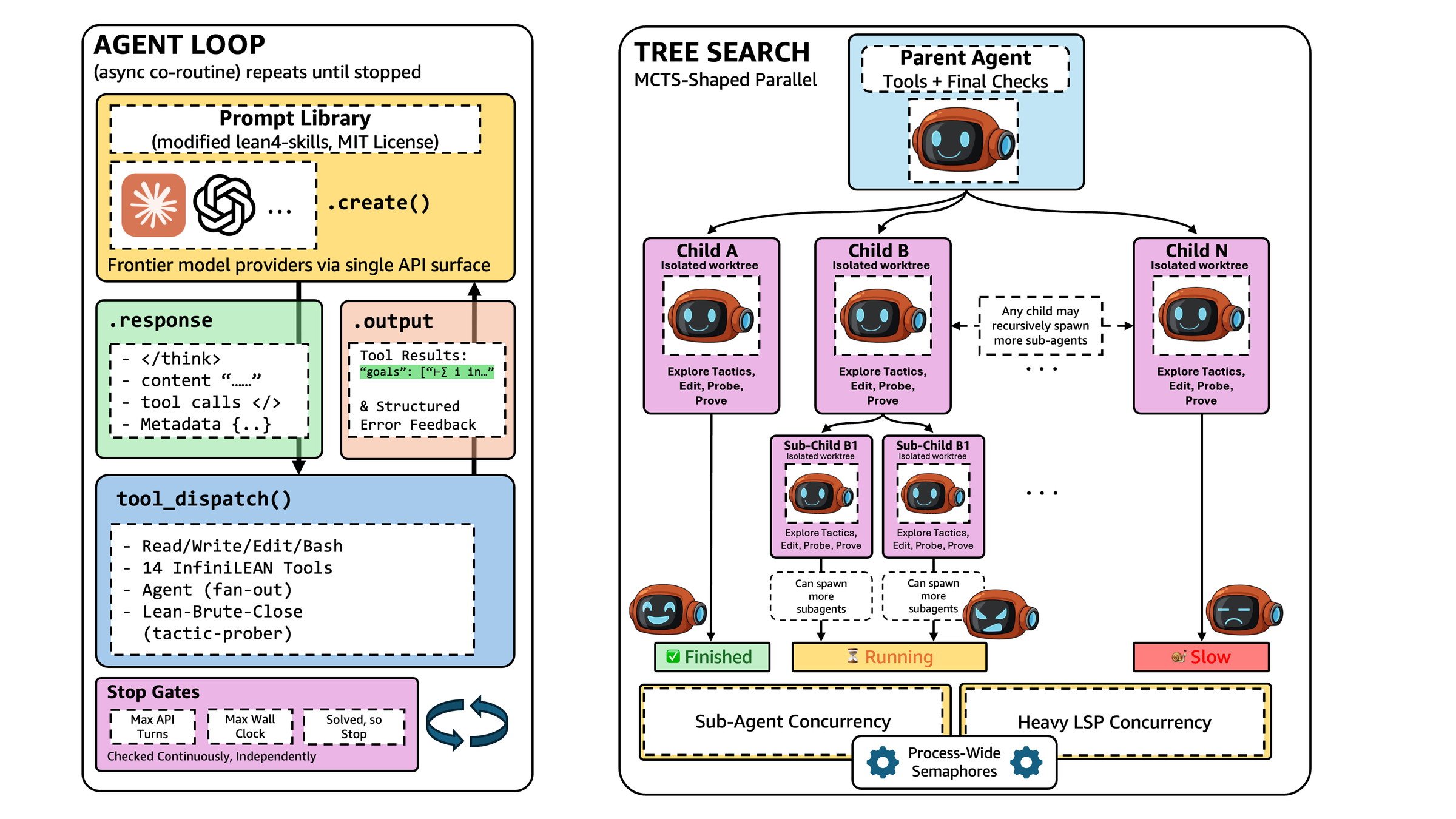
EasyProver, a system that builds machine-checked proofs in the Lean language, resolved tasks on the NTP4VC and VERINA code-verification benchmarks. It used an off-the-shelf model without additional training. It resolved 597 of 600 NTP4VC checks and all 189 VERINA tasks by proof or refutation.
The researchers also built Aegis, a pipeline that turned competitive programming problems into verification tasks for real implementations. It wrote Rust programs, translated them into Lean and generated specifications—statements of intended behavior. It produced 2,045 Rust–Lean program pairs checked against each other and 11,533 candidate specifications. On a sample of 2,000 statements selected across groups, EasyProver proved 1,054, or 52.7%, with a 30-minute budget per statement.
Why it matters
The benchmark results demonstrated code verification without additional model training. Aegis supplied harder tests that included implementation details, such as arithmetic with fixed-size numbers and explicit failures.
Caveats
The harder-task result came from a sample of the authors’ generated statements, and the abstract reported no direct comparison with other provers. The work is a preprint.
In this paper
real-world code verification
- Methods
- EasyProver (this paper)InfiniLean (this paper)Lean Comparator (this paper)Anthropic Fable-5AeneasCharonPlausible
- Datasets
- PutnamBench (evaluated)IMO 2026 (evaluated)NTP4VC (evaluated)VERINA (evaluated)Aegis (this paper)Putnam 2025 (evaluated)AlgoVeri (evaluated)CLEVER (evaluated)
Results
- EasyProver, solved problems, on PutnamBench: 669 of 672
EasyProver solves 669 of 672 PutnamBench problems ( 99.6% ), 72 more than the strongest configuration reported by, which uses natural-language guidance ( 597/672 ).
Formal mathematics.
- EasyProver, solved problems, on IMO 2026: all six; EasyProver, solved problems, on Putnam 2025: all twelve
It also solves all six IMO 2026 problems and all twelve Putnam 2025 problems.
Formal mathematics.
- EasyProver, resolved tasks, on VERINA: all 189; EasyProver, resolved tasks, on AlgoVeri: all 77; EasyProver, resolved tasks, on NTP4VC: 597 of 600
EasyProver resolves all 189 VERINA tasks, all 77 AlgoVeri tasks, and 597 of 600 NTP4VC tasks ( 99.5% ), with 588 proofs and 9 refutations on NTP4VC.
Code verification.
- EasyProver, resolved tasks, on CLEVER, translate to our Lean 4.32 toolchain: 113 of the 143
On CLEVER, it resolves 113 of the 143 tasks that translate to our Lean 4.32 toolchain ( 79.0% ).
Code verification.
- EasyProver, proof rate, on Aegis, edge-case specifications: 84.1%; EasyProver, proof rate, on Aegis, explicit contracts: 31.0%; EasyProver, proof rate, on Aegis, Easy problems: 66.7%; EasyProver, proof rate, on Aegis, Hard ones: 37.6%
The proof rate ranged from 84.1% for edge-case specifications to 31.0% for explicit contracts, and from 66.7% on Easy problems to 37.6% on Hard ones.
Aegis.
What it shows
- EasyProver resolves nearly all tasks in several established mathematics and verification benchmarks using an off-the-shelf frontier model with no additional training.
EasyProver shows that an agentic harness around an off-the-shelf frontier model, with no additional training, can resolve nearly all tasks in several established mathematics and verification benchmarks.
5 Conclusion
- Context isolation decouples total search tree exploration from the history a single agent must keep.
Context isolation thus decouples the total exploration across the search tree from the history that any single agent must keep.
Context isolation and asynchronous returns.
- On a stratified sample of Aegis statements, EasyProver proves 52.7%, showing these verification tasks remain challenging for a prover that nearly saturates established benchmarks.
The same prover proves 52.7% of a sampled set of these statements, so the tasks remain challenging for a prover that nearly saturates current benchmarks.
5 Conclusion
- The Plausible counterexample screening produces no positive labels.
The screen produces no positive labels.
Optional counterexample screening.
Quoted word for word from the full text on arXiv.
The paper
Scaling Lean Theorem Proving for Real-World Code Verification
arXiv, Oct 28, 2026, Open access, CC BY, Preprint, not peer-reviewed
doi.org/10.48550/arxiv.2610.38174
arXiv:2610.38174v1 in cs.CL, also cs.AI, cs.LO, cs.SE
Cite as BibTeX
@misc{ganguly2026scaling,
  title = {Scaling Lean Theorem Proving for Real-World Code Verification},
  author = {Ganguly, Debargha and Raghunathan, Divya and Jovanovi'c, Dejan and Singh, Vikash and Kong, Soonho and Tomb, Aaron and Goel, Aman and Erata, Ferhat and Bayless, Sam},
  year = {2026},
  eprint = {2610.38174},
  archivePrefix = {arXiv},
  primaryClass = {cs.CL},
  doi = {10.48550/arxiv.2610.38174},
  url = {https://arxiv.org/abs/2610.38174}
}