Network structure predicted little in simulated model groups
In simulated populations of 10,000 language-model agents, a measure of network connectivity explained almost none of the variation in final outcomes.
Edited by Boris Djordjevic · Paperfoot
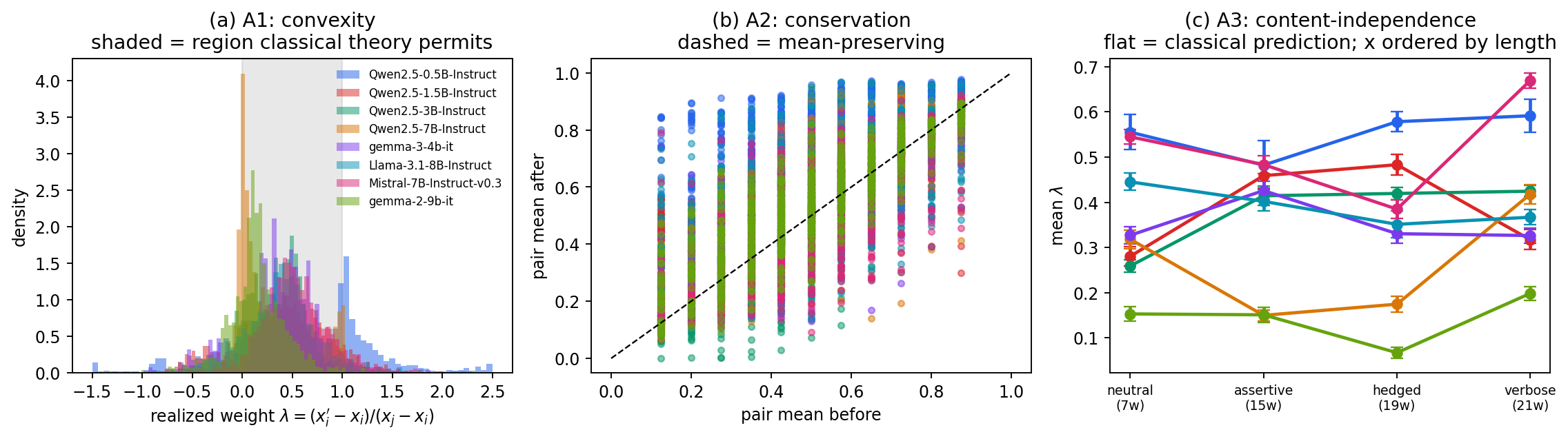
An empirical study measured how eight language models trained to follow instructions revised their confidence across 73,080 controlled exchanges, then simulated 10,000-agent populations using rules fitted to those measurements. The researchers extracted confidence scores from the probabilities models assigned to pieces of text. Models systematically moved outside the range of opinions they observed, breaking the averaging assumption behind classical consensus theory.
In the simulations, a standard measure of network connectivity explained almost none of the variation in final outcomes. Instead, models’ tendencies to shift confidence and how messages were presented governed population behavior. Simulated populations of several models—including some with up to 7 billion parameters, the numerical settings learned during training—repeatedly reached confident agreement on objectively false claims regardless of network structure.
Why it matters
The controlled exchanges challenged the averaging assumptions of classical consensus theory. The simulations suggested that changing network structure alone may not prevent confident agreement on false claims.
Caveats
The population-scale results came from simulations of fitted update rules, not direct exchanges among 10,000 language models. The work is a preprint and has not been peer-reviewed.
From the paper
- Limitation
First, our tested models span 0.5B to 9B parameters, meaning these findings may not perfectly extrapolate to frontier models like GPT, Claude or Gemini, which are far larger and whose token probabilities are often not fully available, so our readout cannot be applied to them directly.
Quoted word for word from the full text on arXiv.
In this paper
collective behavior prediction in multi-agent language model networks
- Methods
- fitted operator (this paper)classical DeGroot averaging (baseline)Qwen-7B (evaluated)Gemma-4B (evaluated)Llama (evaluated)Mistral (evaluated)Gemma-2 (evaluated)3B model (evaluated)0.5B (evaluated)1.5B (evaluated)
Results
- Qwen-7B, percentage of simulated runs ending up believing false claims, simulated runs on false claims: 83%; Gemma-4B, percentage of simulated runs ending up believing false claims, simulated runs on false claims: 88%
Qwen-7B and Gemma-4B drift less on false claims than on true ones, but their overall upward drift is still strong enough that 83% and 88% of their simulated runs end up believing the false claims.
5.6 Validating Corollary 4.4: drift on false claims decides the outcome
- Qwen-7B, final credence, real 12-agent populations in E2 on false claims: 0.73; Gemma-4B, final credence, real 12-agent populations in E2 on false claims: 0.79
Their real 12-agent populations in E2 agree, finishing at credences of 0.73 and 0.79 on false claims.
5.6 Validating Corollary 4.4: drift on false claims decides the outcome
- Llama, final credence, real 12-agent populations on false claims: 0.14; Mistral, final credence, real 12-agent populations on false claims: 0.47; Gemma-2, final credence, real 12-agent populations on false claims: 0.35
Llama, Mistral and Gemma-2 do so while staying high on true claims, and their real 12-agent populations finish at 0.14, 0.47 and 0.35 on false claims.
5.6 Validating Corollary 4.4: drift on false claims decides the outcome
- Llama, slope, regression of final population mean upon starting mean: 0.02
Llama’s slope is near zero ( 0.02 ), because it drifts strongly up on true claims and down on false ones.
5.5 Validating Proposition 4.3: the end point stops depending on the start
- Qwen-7B, drift on false claims: -0.025; Gemma-4B, drift on false claims: -0.015
Qwen-7B and Gemma-4B are close to zero, at -0.025 and -0.015, and their groups still drift up.
5.6 Validating Corollary 4.4: drift on false claims decides the outcome
What it shows
- Hull escape allows the diameter of a network's opinions to grow, so connectivity alone no longer implies contraction toward agreement.
Consequently D is no longer non-increasing, and connectivity alone no longer implies contraction toward agreement.
Proposition 4.1 (Hull escape destroys monotone contraction).
- No non-negative row stochastic weight matrix can reproduce an update that carries a negative realized weight.
If \lambda(x_{i},x_{j},c_{j})<0 for some reachable configuration, then there is no non-negative row stochastic W (the matrix defining the network weights) that reproduces that update, for any choice of weights.
Corollary 4.2 (Negative weights are unrepresentable).
- When an expected per-exchange drift shifts the population mean upward on an interior interval, the population reaches an arbitrary proximity to 1 regardless of its initial mean.
For any b>0 and any m(0), there is a horizon T beyond which the population sits arbitrarily close to 1, independently of m(0).
Proposition 4.3 (Operator bias relocates the fixed point).
- A population converges to high credence in a false proposition whenever its expected shift on that proposition is positive, regardless of initial conditions.
If b>0 on a proposition that is false, the population converges to high credence in that proposition, and no choice of initial condition prevents it.
Corollary 4.4 (Confident false consensus).
- When realized weights depend on message framing, identical graphs with identical initial conditions can follow different trajectories and reach different fixed points.
No function of \mathcal{G} (the network graph) alone predicts the outcome.
Proposition 4.5 (Content dependence underdetermines the graph).
Quoted word for word from the full text on arXiv.
The paper
Network Topology Does Not Matter: The Breakdown of Classical Consensus in LLM Populations
arXiv, Oct 24, 2026, Open access, CC BY, Preprint, not peer-reviewed
doi.org/10.48550/arxiv.2610.37699
arXiv:2610.37699v1 in cs.MA, also cs.AI
Comments: 19 pages, 3 figures, 3 tables
Cite as BibTeX
@misc{dhayalkar2026network,
  title = {Network Topology Does Not Matter: The Breakdown of Classical Consensus in LLM Populations},
  author = {Dhayalkar, Sahil Rajesh},
  year = {2026},
  eprint = {2610.37699},
  archivePrefix = {arXiv},
  primaryClass = {cs.MA},
  doi = {10.48550/arxiv.2610.37699},
  url = {https://arxiv.org/abs/2610.37699}
}