Quantum chip entangled two error-protected qubits
Entangled states had fidelities above 93%, a measure of agreement with the intended state, on a 120-qubit superconducting processor.
Edited by Boris Djordjevic · Paperfoot
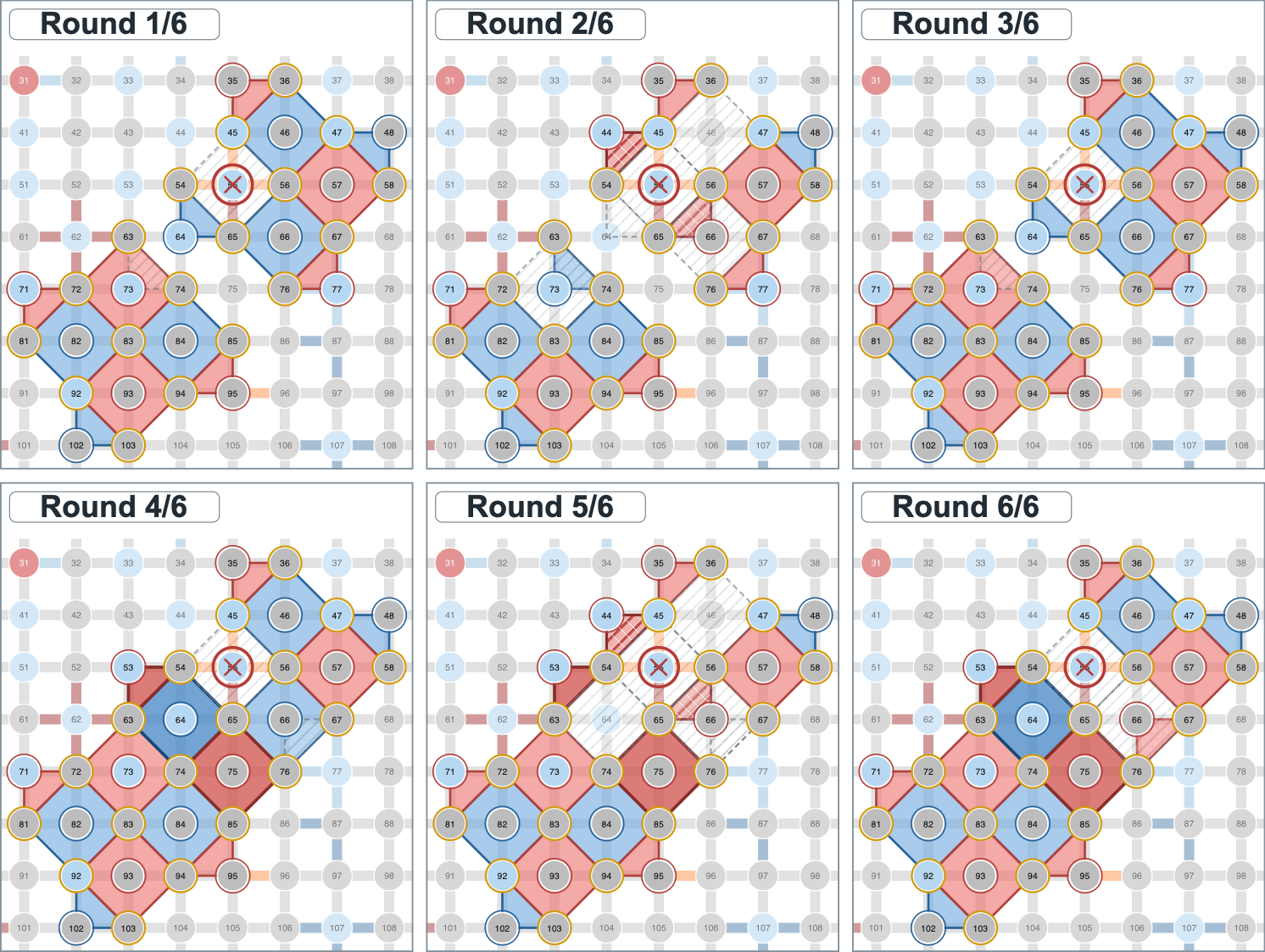
The ibm_phoenix quantum processor demonstrated logical qubit operations using an array of 120 coupled superconducting qubits. A logical qubit encodes information across several physical qubits to protect it from errors. The team excluded underperforming components and used information about noise to interpret error-checking measurements.
They entangled two logical qubits using lattice surgery, a method for joining and separating error-correcting codes. The resulting Bell states—entangled states of two qubits—had fidelities above 93%. Fidelity measures agreement with the intended state. With three logical qubits, the team also used quantum teleportation to transfer states and perform operations, reporting fidelities from 78% to 93%.
Why it matters
The results demonstrated entanglement and teleportation involving error-protected quantum information on physical hardware, rather than in simulation.
Caveats
The demonstrations involved two or three logical qubits; the abstract does not report a larger logical-qubit computation. The work is a preprint and has not yet been peer-reviewed.
In this paper
fault-tolerant logical qubit operations and quantum error correction
- Methods
- defect exclusion (this paper)ancilla re-purposing (this paper)walking circuit (this paper)Belief Matching decoderlattice surgery
Results
- defect exclusion, logical error per round, distance-5 memory experiment: 0.9%
These techniques halve the logical error per round in a distance-5 memory experiment, from 1.9% to 0.9%.
I introduction
- lattice surgery, logical Bell-state fidelity, using defect exclusion: above 93%
We also demonstrate logical entanglement between pairs of logical qubits using lattice surgery, with logical Bell-state fidelity above 93% using defect exclusion.
I introduction
- lattice surgery, fidelities, with three logical qubits and lattice surgery: in the range 78% - 93%
With three logical qubits and lattice surgery, we perform logical teleportation of a range of states and gates, observing fidelities in the range 78% - 93%.
Abstract
- walking circuit, failed decoding attempts, At 170 rounds, with 50 million runs: 8
For this data point, with 50 million runs we observed 8 failed decoding attempts.
II.4 Fast resets to counter leakage
What it shows
- Underperforming qubits significantly limit logical error suppression on quantum processors unless defect exclusion strategies are applied.
While theory and simulations predict that the average performance of the components of ibm_phoenix are below an error threshold, where increasing the code distance should suppress logical errors, we find that underperforming qubits limit this logical error suppression significantly.
II.1 High-fidelity logical qubits
- Informing the decoder about underperforming components is not sufficient to achieve logical errors per round below 1%, requiring active adaptation of syndrome extraction circuits via ancilla repurposing.
… the need for ancilla re-purposing to achieve logical errors per round below 1% demonstrates that informing the decoder about the underperforming components is not itself sufficient and that we must actively adapt the syndrome extraction circuits …
II.1 High-fidelity logical qubits
- Resetting qubits during repeated syndrome extraction measurements returns them to the qubit subspace, eliminating the compounding of leakage errors.
Qubits that are reset during the repeated syndrome extraction measurements are returned to the qubit subspace, thereby eliminating the potential for leakage errors to compound on these qubits.
II.4 Fast resets to counter leakage
- In stability experiments without resets, the reduction in probability of error tapers as the number of syndrome measurement rounds increases due to uncorrected leakage errors.
Without resets, we see a tapering in the reduction of probability of error in the stability experiment as the number of syndrome measurement rounds is increased.
II.4 Fast resets to counter leakage
Quoted word for word from the full text on arXiv.
The paper
Entangled logical qubits on a superconducting quantum processor
arXiv, Oct 23, 2026, Open access, Preprint, not peer-reviewed
doi.org/10.48550/arxiv.2610.32347
arXiv:2610.32347v1 in quant-ph
Comments: 22 page, 15 figures, comments welcome
Cite as BibTeX
@misc{harper2026entangled,
  title = {Entangled logical qubits on a superconducting quantum processor},
  author = {Harper, Robin and Kolesnikow, Xanda C. and McLauchlan, Campbell K. and Nixon, Georgia M. and Bartlett, Stephen D. and Brown, Benjamin J.},
  year = {2026},
  eprint = {2610.32347},
  archivePrefix = {arXiv},
  primaryClass = {quant-ph},
  doi = {10.48550/arxiv.2610.32347},
  url = {https://arxiv.org/abs/2610.32347}
}