Quantum search on a two-dimensional grid faces a speed limit
A proof shows that a quantum walker hopping across a two-dimensional grid needs extra steps to find a target, resolving an open question from 2003.
Edited by Boris Djordjevic · Paperfoot
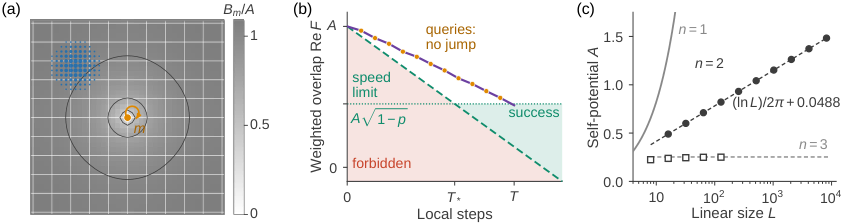
In a preprint reporting a theory result, the authors proved that a quantum walker hopping between neighboring sites of a two-dimensional lattice cannot search the grid in Grover's search time. This proof resolves an open question posed by Aaronson and Ambainis in 2003. For an L by L lattice with N sites, the walker needs at least a number of local steps proportional to the square root of N log N to find a marked vertex, even with unlimited memory and free queries. The result shows that an existing method, Tulsi's algorithm, is asymptotically optimal.
The proof connects quantum spatial search to classical electrostatics, the physics of electric charges. Treating the marked vertex as a point charge reveals a lower bound—a limit no algorithm can beat—set by the charge's self-potential. When multiple vertices are marked, the limit depends on their arrangement through capacitance.
Why it matters
The mathematical proof settles a question open since 2003 by establishing the absolute speed limit for quantum search on two-dimensional grids. By proving that Tulsi's algorithm is optimal, it shows that no quantum walker can overcome the extra logarithmic time penalty when moving across a flat lattice.
Caveats
The result is a mathematical proof that applies specifically to quantum walkers hopping between neighboring sites on a two-dimensional lattice. The paper is also a preprint that has not yet been peer-reviewed.
In this paper
- Methods
- Tulsi's algorithm (evaluated)
What it shows
- A quantum walker needs at least Ω(√N log N) local steps to find a marked vertex on a two-dimensional lattice, resolving an open question posed by Aaronson and Ambainis.
A walker that hops between neighbouring sites of an L× L lattice, N=L2, needs Ω(√Nlog N) local steps at least to find a marked vertex, even with unlimited memory and free queries.
Abstract
Quoted word for word from the abstract on arXiv.
The paper
Electrostatic Limits on Quantum Spatial Search
arXiv, Oct 16, 2026, Open access, CC BY, Preprint, not peer-reviewed
doi.org/10.48550/arxiv.2610.23560
arXiv:2610.23560v1 in quant-ph, also cs.CC
Cite as BibTeX
@misc{li2026electrostatic,
  title = {Electrostatic Limits on Quantum Spatial Search},
  author = {Li, Weikang},
  year = {2026},
  eprint = {2610.23560},
  archivePrefix = {arXiv},
  primaryClass = {quant-ph},
  doi = {10.48550/arxiv.2610.23560},
  url = {https://arxiv.org/abs/2610.23560}
}