Tracking activity lifts scores on harder interaction tests
Adding activity scores to four interaction-prediction models without retraining raised average precision by up to 25 percentage points in two harder test settings.
Edited by Boris Djordjevic · Paperfoot
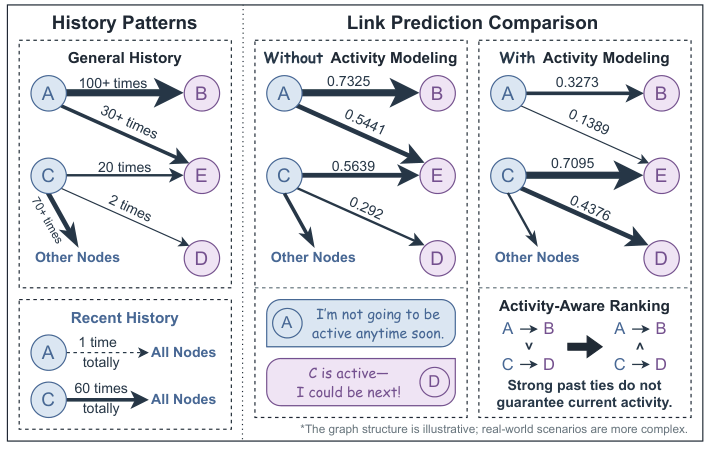
Source Node Activity Modeling, a model with fewer than 20 adjustable values, modeled activity in time-stamped interaction datasets using past interaction counts. It gave older events less weight. The researchers proved that standard false training and test examples, made by keeping the initiator and swapping the recipient, gave models no reward for learning the initiator’s activity.
In two harder test settings whose false examples had different initiators, adding its scores to four existing interaction-prediction models without retraining improved average precision, a measure of prediction quality. Compared with those models’ unchanged scores, gains reached up to 25 percentage points, with improvements on almost every model-dataset pair in both settings. The authors’ full model ranked first overall against eleven baselines across 13 datasets and three testing protocols.
Why it matters
The proof identified information that standard training and testing did not reward models for learning. Dataset tests showed that a small activity model could add that information to several existing models without retraining them.
Caveats
The abstract does not name the datasets or report variation across runs. The work is a preprint and has not yet been peer-reviewed.
In this paper
temporal link prediction
- Methods
- Source Node Activity Modeling (SNAM) (this paper)Multi-Timescale Historical Representation (MTHR) (this paper)Candidate Relation Modeling (CRM) (this paper)Ours +\lambda (this paper)JODIE (baseline)TGN (baseline)CAWN (baseline)EdgeBank (baseline)GraphMixer (baseline)NAT (baseline)PINT (baseline)DyGFormer (baseline)
- Datasets
- Wikipedia (evaluated)Reddit (evaluated)MOOC (evaluated)LastFM (evaluated)Enron (evaluated)Social Evo. (evaluated)UCI (evaluated)Flights (evaluated)Can. Parl. (evaluated)US Legis. (evaluated)
- Links
- Code
Results
- Ours +\lambda, average rank, transductive link prediction under three negative sampling strategies: 2.44
Our full model (Ours +\lambda ) achieves the best overall average rank of 2.44, primarily benefiting from historical and inductive negatives.
5.2 Overall Effectiveness and Efficiency
- Ours +\lambda, average rank, without SNAM, transductive link prediction: 4.33
Without SNAM, our model still outranks the strongest baseline, TPNet (4.33 vs. 4.55).
5.2 Overall Effectiveness and Efficiency
- Source Node Activity Modeling (SNAM), average rank, historical negatives: 1.50; Source Node Activity Modeling (SNAM), average rank, inductive negatives: 1.54
SNAM improves the respective average ranks from 4.42 and 4.31 to 1.50 and 1.54, surpassing all baselines and supporting the complementarity of activity and relation scoring.
5.2 Overall Effectiveness and Efficiency
- Ours +\lambda, training speed per epoch, million-event streams: 9-100x faster
Our full model ranks first overall against eleven baselines on 13 datasets and three protocols, and on million-event streams trains an epoch 9-100x faster than TPNet and DyGFormer.
Abstract
- Source Node Activity Modeling (SNAM), AP increase, added to frozen backbones under historical negatives: up to 16.39 percentage points
Under historical negatives, AP improves across all 20 backbone–dataset combinations by up to 16.39 percentage points.
5.3 SNAM: Does the Activity-Based Approach Really Work?
- Source Node Activity Modeling (SNAM), AP increase, added to four frozen backbones: up to 25 percentage points
Added to four frozen backbones, it improves AP on almost every backbone–dataset pair by up to 25 percentage points.
6 Conclusion and Future Work
What it shows
- A standard negative sample keeps the real source node and swaps the destination, canceling the source's activity exactly from the optimal score so no model trained and evaluated this way is rewarded for learning it.
Temporal link prediction has concentrated on the second, and we show that it is blind to the first by construction: a standard negative keeps the real source and swaps the destination, and we prove that this cancels the source's activity exactly from the optimal score, so no model trained and evaluated this way is ever rewarded for learning it …
Abstract
- Any factor held fixed by a negative sampler between a positive and its negatives drops out of the optimal score.
The cancellation argument is not specific to source activity: any factor that a negative sampler holds fixed between a positive and its negatives drops out of the optimal score, so the sampler decides what a model can learn and what a metric can see.
6 Conclusion and Future Work
- SNAM uses only K+1 learnable parameters shared across all source nodes without depending on any other trainable parameters.
The module contains only K+1 learnable parameters shared across all source nodes, and the computation of \lambda_{u}(t) does not depend on any other trainable parameters.
4.3 Source Node Activity Modeling
- Trained SNAM parameters can be directly reused across models without model-specific retraining under consistent historical statistics, time units, and decay-scale configurations.
Furthermore, under consistent historical statistics, time units, and decay-scale configurations, trained SNAM parameters can be directly reused across models without model-specific retraining.
SNAM: Beyond an Integrated Component.
- On LastFM, TPNet and DyGFormer require approximately 9.2x and 60x the proposed model's per-epoch training time, and 1.7x and 27x its full-test-set scoring time.
TPNet and DyGFormer require approximately 9.2× and 60× our per-epoch training time, and 1.7× and 27× our full-test-set scoring time, respectively.
5.2 Overall Effectiveness and Efficiency
Quoted word for word from the full text on arXiv.
The paper
arXiv, Oct 4, 2026, Open access, Preprint, not peer-reviewed
doi.org/10.48550/arxiv.2610.04869
arXiv:2610.04869v1 in cs.LG, also cs.SI
Comments: 62 pages, 6 figures, 19 tables
Cite as BibTeX
@misc{zhang2026your,
  title = {Your Temporal Link Predictor Is Blind to Who Is Active: A Missing Factor That Transfers Across Models},
  author = {Zhang, Ji and Liu, Zixin and Ding, Yiran and Wang, Jiayi and Du, Yilu and Xuan, Weijia},
  year = {2026},
  eprint = {2610.04869},
  archivePrefix = {arXiv},
  primaryClass = {cs.LG},
  doi = {10.48550/arxiv.2610.04869},
  url = {https://arxiv.org/abs/2610.04869}
}